
Written by Rylee McMillan and Adrienne Keller
At The Nature Conservancy’s Newell and Ann Meyer Preserve in Wisconsin, USA, managers face an increasingly difficult challenge: understanding the trade-offs and benefits of managing for carbon outcomes among other management objectives.
This challenge is not unique. Ecosystems globally are witnessing clear and intensifying effects of climate change, driving a growing interest in using natural lands for their inherent carbon storage abilities. However, carbon management strategies can be at odds with other management objectives. For example, at the Meyer Preserve, managers question whether the desire to maintain biodiversity conflicts with optimizing carbon storage.
Managing for potentially divergent goals calls for a strong understanding of local-scale trade-offs that can be difficult to quantify over time. To support this undertaking, authors Keller et al. outline a five-pillar framework for qualitatively assessing management trade-offs, which they developed and tested at the Meyer Preserve.
Read on to learn more from lead author Dr. Adrienne Keller about the framework and its applications.
How was the Framework Conceptualised and who was Involved in the Process?
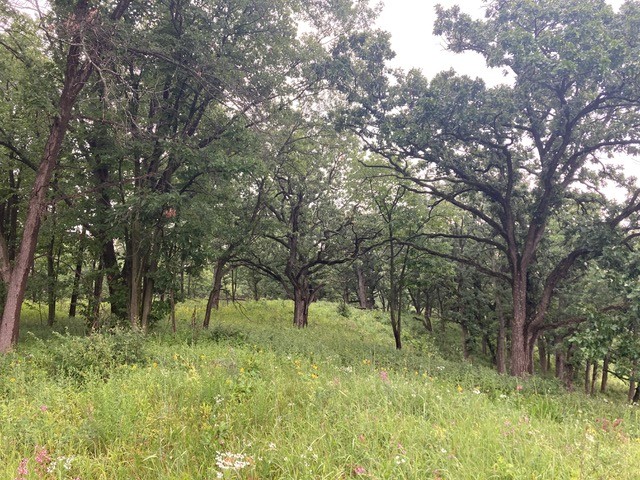
The Nature Conservancy was eager to use the Newell and Ann Meyer Nature Preserve as real-life case study to explore how managing for both climate mitigation and biodiversity goals could lead to trade-offs. Natural resource professionals with The Nature Conservancy collaborated with research scientists and climate adaptation specialists over several years to co-produce an assessment of trade-offs across the Meyer Preserve, primarily focused on the Preserve’s oak savanna stands.
The collaboration began with a series of virtual team meetings and a field site visit to define the scope of the project. During the visit, our interdisciplinary team asked questions amongst ourselves such as “what taxa and scale of biodiversity is our management focus on the Meyer Preserve?” (answer: oak savanna-dependent plant biodiversity) and “is the Meyer Preserve’s primary goal to take up and store as much carbon as possible?” (answer: carbon was deemed important, but secondary, to the plant biodiversity). The site visit was an invaluable opportunity for knowledge exchange, and it informed the eventual creation of our framework.
How was the Framework Developed and Applied at the Meyer Preserve?
The framework was formed over time through sustained collaboration and tested through application across oak savannas at the Meyer Preserve. During the site visit, we refined management goals to enable clear comparison of trade-offs (Pillar 1 of our framework). From these conversations, we realised a need to increase carbon confidence and competency within the team. In response, we developed a set of targeted science communication tools that outline the fundamentals of ecosystem carbon science (Pillar 2). This included a “Carbon Cycling 101” presentation and a series of topical technical primers. These tools provided our team with necessary context, which we relied on in future phases of our work.
Next, we met to assess the vulnerability and anticipated impacts of climate change at the Meyer Preserve (Pillar 3). Through discussion, it was revealed that the greatest concerns for the site related to shifting fire regimes, woody encroachment, mesophication, and invasive species and disease outbreaks. We defined management actions that could combat these threats, such as thinning invasive woody species, and performed a rapid literature review to evaluate their anticipated effects (Pillar 4). Our assessment provided helpful predictions about how the selected management pathways could alter local carbon pools and fluxes across different timescales. We presented this information via an interactive visual activity that showcased the direction and magnitude of management trade-offs (Pillar 5).
You can read more about each of these steps and the outputs they produced in our publication!
What’s Next?
The application of our five-pillar framework at the Meyer Preserve demonstrates that qualitative assessment can be an effective tool for determining and conveying the trade-offs and co-benefits associated with carbon management at local-scales. Our approach encourages the integration of knowledge generated through research, local experience, and other ways of knowing to produce informed management objectives. We hope that this project will motivate others to consider how the qualitative assessment of carbon management trade-offs could benefit their sites, and to apply our framework as it relates to their situation.
Dr. Keller invites readers interested in learning more about this project to visit her website https://www.adriennebkeller.com/ or contact her at kellerab@mtu.edu.
 The Applied Ecologist