Shortlisted for the Chico Mendes Prize
About the research
Overview
Our paper asks a simple but uncomfortable question: why do so many species recovery strategies fail to translate into recovery outcomes? Using more than a decade of collaborative work on the endangered semi-aquatic queensnake (Regina septemvittata) in Ontario, we developed and tested a framework for coordinating recovery actions across agencies and organizations. Recovery actions are often treated as separate projects and in many cases rests on best available knowledge of varying quality. To overcome this challenge we structured them as one integrated initiative. We show that intentional governance, shared data systems, and sustained coordination can dramatically accelerate implementation, with over 90% of identified recovery actions completed in under a decade.
Surprises and challenges
I was surprised that the main challenge to the project was not ecological uncertainty. We often know what needs to be done. The challenge was to make different mandates, funding streams, and timelines cohesive. Personally, I had to learn to listen actively and interact with participants on a much more personal level than I was used to. Building trust across agencies, NGOs, consultants, landowners, and researchers required patience and humility. Coordinating long-term data stewardship and maintaining momentum over many years was incredible difficult as well, but it ultimately proved more important than any single technical innovation.
Next steps and broader implications
The next step is scaling coordination without losing trust. Many recovery efforts remain unintentionally siloed. I think we need systems that embed collaboration, shared data standards, and policy relevance from the beginning. There is also important work to do in meaningfully integrating Indigenous leadership and knowledge systems into recovery governance. Our collaborative strives to make this aspect a much stronger part of our initiative. Our project describe how knowledge gaps can be addressed, but I think more broadly conservation science must continue moving from describing problems toward operational frameworks that help implement solutions at landscape scales. That’s again an uncomfortable question to face, but one we are trying to incorporate into our ongoing work with the queensnake.
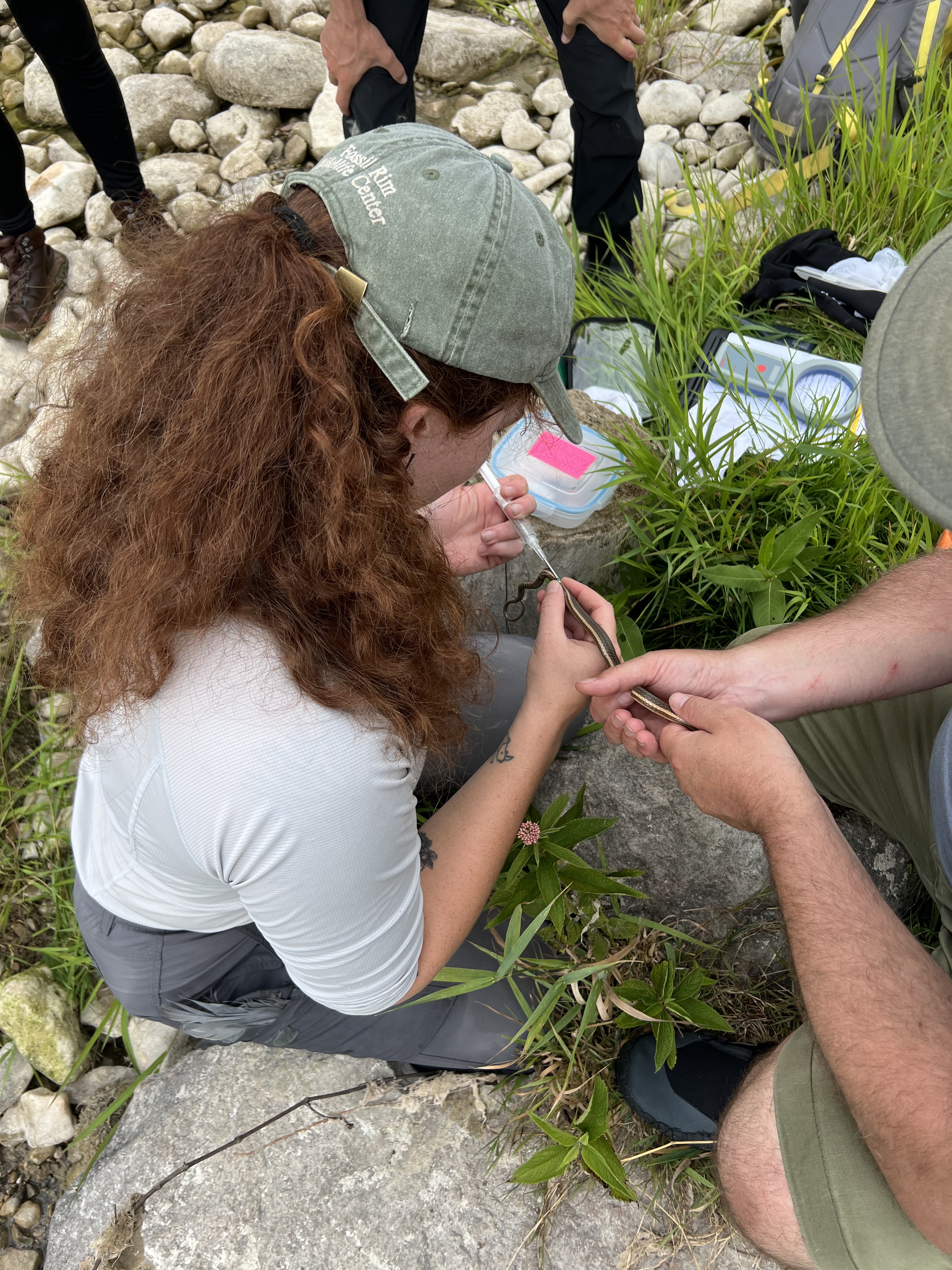
Our work shows that recovery can move faster when governance is treated as seriously as biology. By aligning research design with policy needs and centralizing coordination, we reduced duplication, improved data quality, and supported decision-making under Canada’s Species at Risk Act. Our manuscript (thanks to also the reviewers) attempts to make our framework modular and transferable to other species and communities. We certainly think it offers a practical model for other jurisdictions seeking to turn recovery strategies into measurable outcomes rather than well-intentioned documents.
About the author
Current position
I am a Mitacs Postdoctoral Fellow in the Department of Biology at Queen’s University, Canada where I study dispersal, population structure, and the evolutionary consequences of movement across ecological scales.
Getting involved in ecology
I grew up near the west coast in the Jutland peninsula in Denmark where heavily developed areas meet the harsh coastline and its natural environment. As a kid, I always took notes of birds and their behaviours, but ultimately I lacked the tools to answer my questions. As I grew into adulthood I forgot all these amazing times out in nature and it wasn’t until I ended up in the Northern Territory, Australia on a large cattle station that I was reminded about my childhood interests in nature. So, in my late 20s I went back to school to learn the tools to answer questions that I sought as a kid. I wasn’t eligible for the biology program at Danish universities, so I travelled to the University of Iceland in Iceland where I finally was able to immerse myself in science and in particularly in ecology for which I have a deep passion.
Current research focus
I absolutely have. The work actually started back in 2012. At that time I wasn’t sure whether I would be accepted to the PhD program at the University of Toronto. So, to make ends meet I worked with a stewardship group in Huron County, Ontario where I eventually, and alongside my PhD, became part of the core group that developed the research the paper describes. I continue this work now as a Post Doctoral Fellow researcher where I now get to focus all my efforts on this work. I am very excited for these next few years as the project develops and If I am lucky it may become my core research program.
Advice for fellow ecologists
It’s always difficult to give advice that will be meaningful to everyone. My biggest fear in any school setting was that I struggled with maths. All the time. I developed so much anxiety from maths that I left school early, and which is why I wasn’t allowed to enrol at biology programs at universities in Denmark. So, I cast away that dream until I remembered it again much later in the desert of Australia. Fears for any subject or discipline can be extremely difficult to deal with, and in some cases perhaps not worth facing. However, when fear becomes an obstacle that sidetracks you from pursuing your dreams and ideas I encourage students to think hard about what it would mean for their careers and lives by walking away. I was eventually mature enough to face my fear of maths, and although I am happy where I am at, I do wish I had had the courage to face my maths fear much earlier.
Read the full article Fast-tracking species at risk conservation: A framework for addressing recovery actions through multi-agency collaboration in Ecological Solutions and Evidence.
Queensnake collaboration website: https://queensnakerecovery.wixsite.com/qusn
 The Applied Ecologist