Reforestation and forest restoration require large numbers of high-quality seeds and seedlings. In Austria, seeds of silver fir—a species important for adapting forests to climate change—are often of low quality. Therefore, it would be helpful to identify the factors that affect seed quality so we can better predict and plan seed harvests. Our study looked at whether seed quality differs between seeds from seed orchards and certified seed stands, and how seed quality in seed stands relates to their biotic and abiotic characteristics.
We collected seeds from 63 certified seed stands and six seed orchards across Austria and planted them in an experimental garden. We measured how many seedlings successfully emerged from the seeds. We then analyzed how seedling emergence varied in response to tree age, proportion of forest cover where silver fir is present, climate conditions, and seed weight.
Our results showed that seeds were more likely to grow into healthy seedlings if they came from stands with a higher mixed silver fir forest cover and from stands with older trees. Mean annual temperature was also positively related to seedling emergence, but only when there was enough rainfall at the seed stand site. Lastly, seeds from seed orchards had significantly higher emergence and seed weight than those from seed stands.
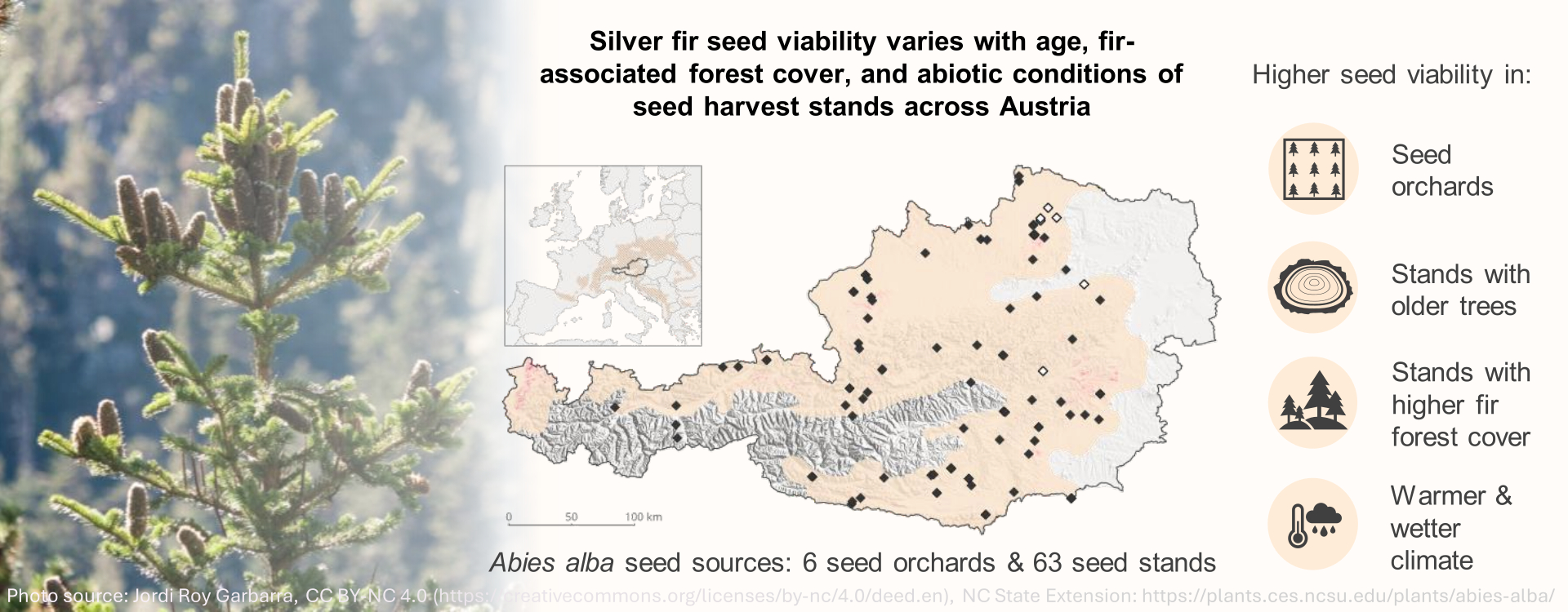
These findings show that both seed stand biotic characteristics (like tree age and species abundance) as well as climate conditions are important to consider when choosing and managing seed sources. Seed stands with older trees tended to produce higher-quality seeds, possibly because they are more dominant and have better access to resources. Moreover, our results support the notion that seed orchards produce seed with higher quality and should therefore be supported and their use expanded whenever possible.
This study brought us one step closer to understanding which factors influence seed quality. This knowledge will help us select stands that are better suited for quality seed production, decide how to manage them to optimize their reproduction, and therefore, collect seeds of highest quality to aid forest regeneration under changing environmental conditions.
This is a Plain Language Summary discussing a recently-published article in Journal of Applied Ecology. Find the full article here.
 The Applied Ecologist