Insect farming is often promoted as a sustainable alternative to conventional livestock, with the potential to reduce land use, emissions, and pressure on natural resources. However, scaling up any food production system also carries environmental risks. In this study, we show that one important risk – biological invasions caused by escaped farmed species – has received far too little attention in the rapidly growing insect farming sector.
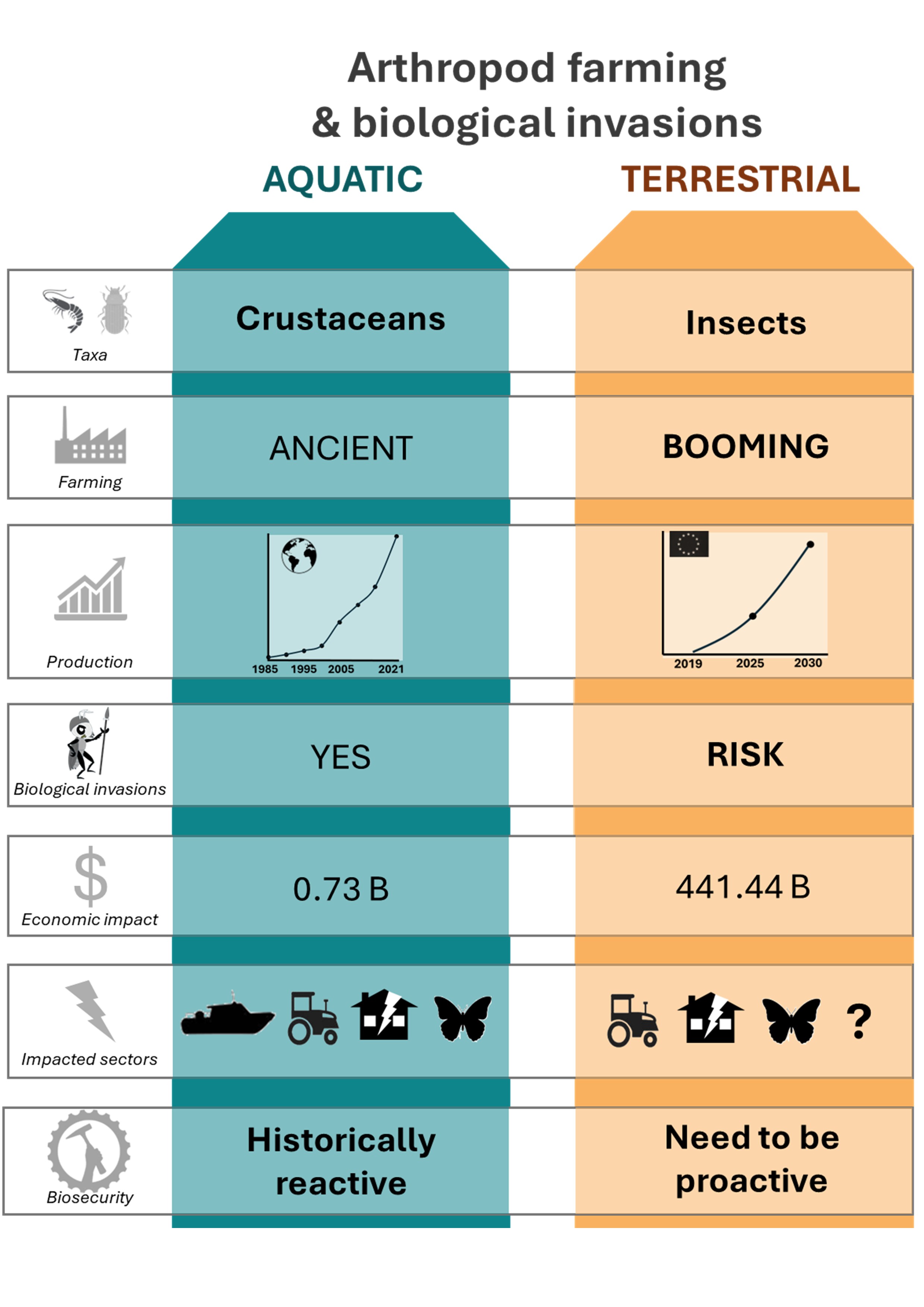
We examined how biological invasions have emerged from animal farming, focusing especially on aquaculture, where non-native species escapes are well documented and have caused major ecological and economic damage worldwide. We then compared aquaculture with insect farming to identify shared features that increase invasion risk. These include the farming of fast-growing, highly adaptable species, production at high densities, farming outside native ranges, and limited biosecurity and regulation during early industry expansion.
Our analysis shows that many of the same conditions that enabled invasions from aquaculture are now present in insect farming. While there are currently no documented ecological impacts from escaped farmed insects, this likely reflects a lack of monitoring rather than an absence of risk. In contrast, aquaculture provides clear evidence that once invasive species become established, they are extremely difficult and costly to control.
Importantly, we also show that insect farming does not need to repeat these mistakes. Tools already used in aquaculture such as screening species for invasion risk, farming species within their native ranges where possible, strengthening biosecurity, and applying precautionary regulation, can be adapted to insect farming now, before large-scale impacts occur.
We argue that preventing invasions is far more effective and less costly than responding after the fact. As insect farming expands globally, especially in regions where food security challenges are greatest, early and proactive governance are essential. Learning from the past allows insect farming to fulfil its sustainability promise without creating new environmental problems.
This is a Plain Language Summary discussing a recently-published article in Journal of Applied Ecology. Find the full article here.
 The Applied Ecologist