Background
Managed forests often become structurally simple: fewer layers, less deadwood, and a poorer understory. Retention forestry tries to avoid this by keeping key habitat features during timber use. Spiders matter because they are common predators in forests, but we still need clearer evidence on which forest features support them, and whether food availability plays a role.
What did we study?
We worked in 55 managed forest plots in the Black Forest (Germany). We sampled ground-dwelling spiders with ground traps and, from the same traps, counted common potential prey consisting of flies, bugs and and springtails. We then linked these data to forest conditions that managers can influence: canopy cover, share of conifers, lying deadwood, understory plant diversity, and overall stand structure (here we referred to how varied the forest is in layers, gaps, and tree sizes).
What did we find?
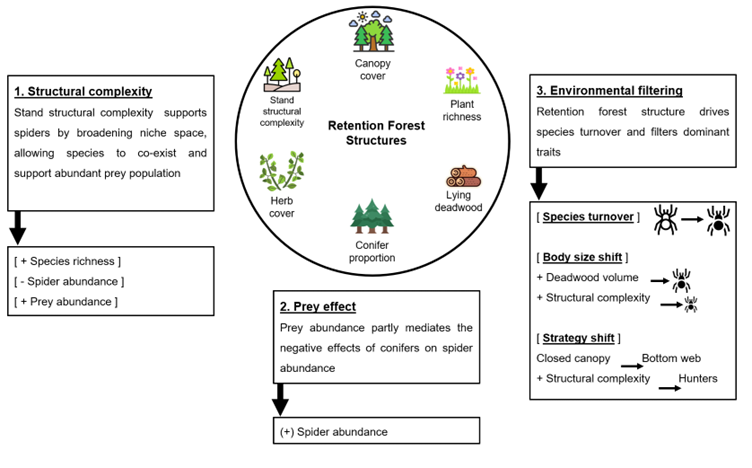
Forests with more varied stand structure tended to support more spider species. Stands with a high share of conifers held fewer spiders, and part of this pattern matched lower prey availability in those stands. Where prey was more abundant, we generally found more spiders, but this did not translate into a higher number of spider species. Forest structure also shifted which spiders were most common: more lying deadwood was linked to larger-bodied spiders, more structurally varied stands favoured smaller spiders and active hunters, and closed canopies favoured spiders that build low webs close to the ground.
What does this mean for practitioners?
If the aim is to support spiders and their ecological role in managed forests, retention forestry should keep forests structurally diverse: maintain layered stands, retain lying deadwood, and promote a diverse understory. Avoiding strong dominance by conifer stands may also help by sustaining prey and, in turn, spider populations.
This is a Plain Language Summary discussing a recently-published article in Journal of Applied Ecology. Find the full article here.

