
Written by Alec Christie, Centre for Environmental Policy, Imperial College London.
For more than two decades, conservationists have been encouraged to use the best available evidence to inform their decisions – a concept called ‘Evidence-based Conservation’. The idea is simple: rather than relying only on personal experience, tradition, or intuition, practitioners should draw on evidence from the wider literature and other forms of knowledge to do more of what works and less of what doesn’t. But has this movement actually changed conservation practice?
Our new study tentatively suggests the answer is yes. Awareness and possibly implementation of evidence-based practice is spreading across conservation and environmental management, but it is still far from routine.
What did we do?
To explore this, we looked for simple signals that organisations were using evidence and following evidence-based principles over time. We examined around 162,000 conservation and environmental job adverts posted between 2002 and 2025, along with scientific papers and practitioner-facing documents such as reports and guidance. We searched for keywords linked to evidence-based practice, such as references to consulting literature and evidence to inform decisions, or making decisions based on evidence.
What did we find?
The overall pattern was clear: mentions of evidence-related terms have increased in all three sources over the past two decades. The year-on-year rise was especially rapid in percentage terms for job adverts, where organisations increasingly signal that they value evidence in their organisational descriptions or explicitly in job descriptions or role requirements. This is a promising sign. It suggests that evidence-based practice is becoming more visible, more normalised, and more commonly expected.
But the bigger picture is more sobering. Even though mentions have increased, the current prevalence is still modest at best. In recent years, only a small share of job adverts and organisations explicitly referred to evidence use. Evidence-based practice appears more common in the public sector than in charities, not-for-profits, or private companies, which suggests that uptake is uneven across the conservation community.
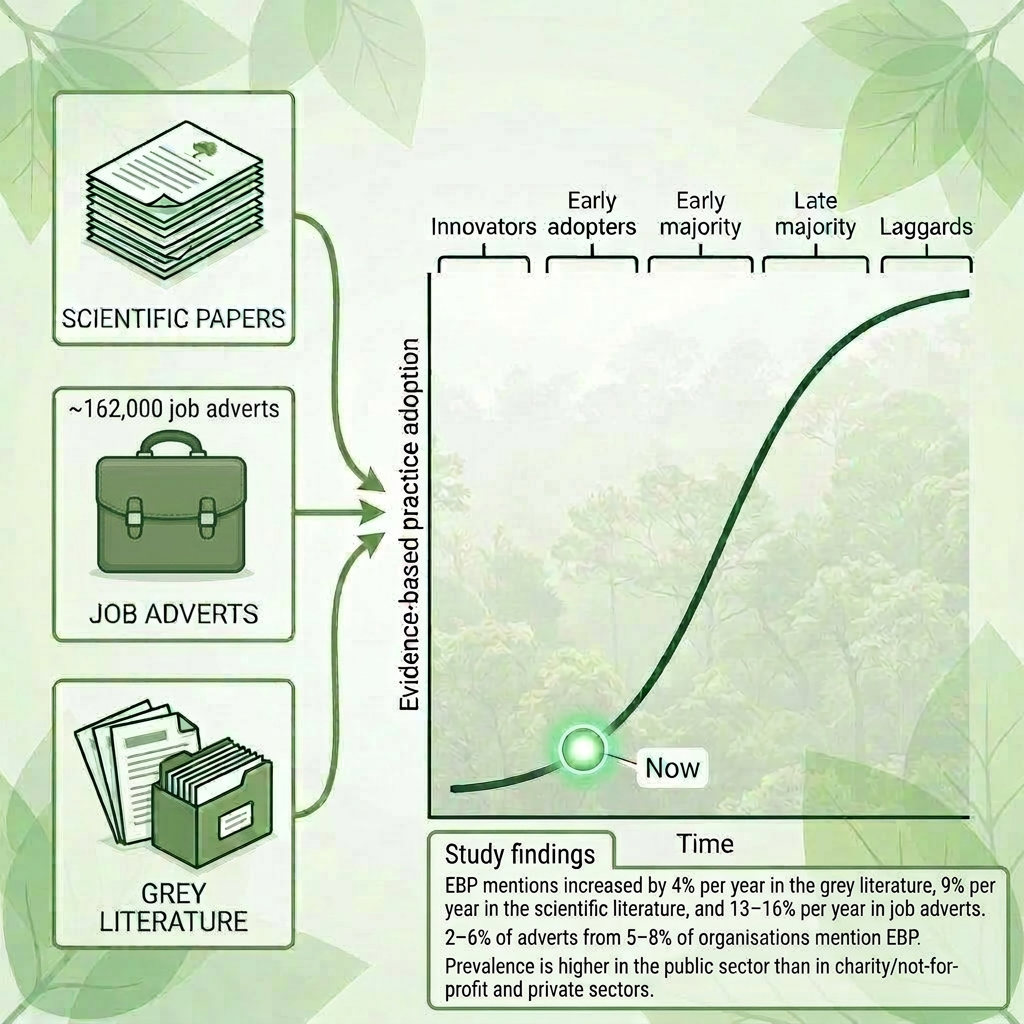
We also asked whether these trends fit a classic theory of how new ideas spread: diffusion of innovations. This theory suggests that adoption usually begins slowly with ‘innovators’ taking the lead, accelerates as the idea gains traction among other individuals. This curve eventually levels off as a percentage of the population never end up adopting the idea, creating an ‘S’-shaped curve. Our results look consistent with this pattern. In other words, conservation and environmental management may still be in the early phase of adoption, where awareness is growing but widespread implementation has not yet taken hold.
What does this mean for conservation?
These findings matter because it changes how we think about progress towards achieving more evidence-based conservation. If evidence-based practice is still in an early adoption stage, then the challenge is to support the many organisations that may be aware of the idea but have not yet had the time, tools, confidence, or incentives to make it part of everyday work.
So what does this mean for those promoting evidence-based practice in conservation and environmental management?
First, we need to be clear about what evidence-based practice actually looks like and use consistent terminology. It is not just a label or a slogan but we need to generate consensus across those working in academia, practice, business, and policy. We also need to think wisely about how we spend resources on being evidence-based – i.e. in which situations should organisations invest more in evidence-based practice. For example, triaging rigorous evidence use for decisions with bigger potential costs and consequences, rather than day-to-day tasks. Making this clearer might help us improve adoption so those working in conservation see evidence-based practice as a more manageable commitment, without diverting too much precious time and resources from conservation action.
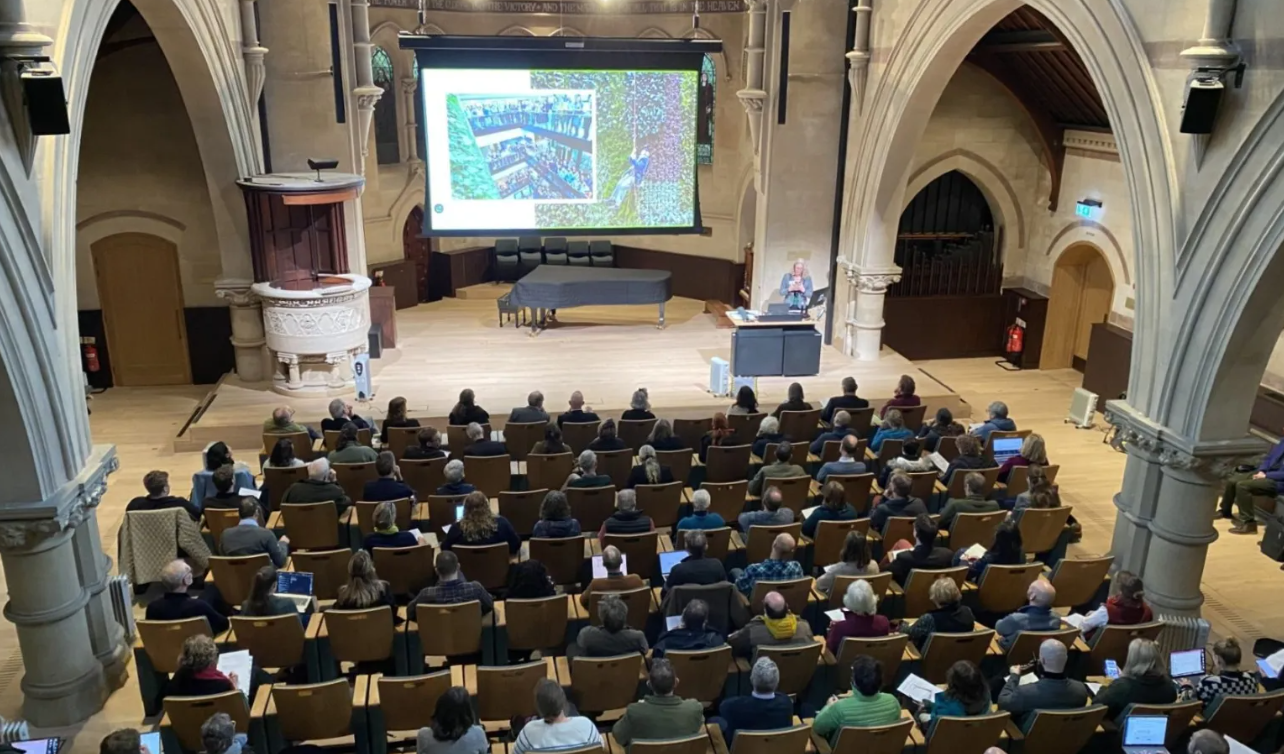
Second, support needs to be tailored. Some organisations may need help getting started, while others may need tools to embed evidence use into routine workflows. Practical guidance, training, mentoring, and recognition schemes could all help move evidence use from aspiration to habit. The Evidence Champions scheme at Conservation Evidence is a good example of this, where large gatherings of conservation organisations have been sharing ideas on what embedding evidence in practice really looks like – these are our ‘innovators’ and ‘early majority’ from diffusion of innovations theory, but we need to reach out wider than this.
Third, we should be mindful of the potential for ‘evidence-washing’ — claiming to be evidence-based without making meaningful changes to how decisions are made. If the goal is better conservation outcomes, then the focus should be on genuine implementation, not just on language. But we also need to accept that we often use different words to mean similar things, so clear communication and supporting organisations transition towards being more evidence-based is the way forward.
Two decades on from the first calls for evidence-based conservation, the field has made some good progress. But our study suggests there is still a long way to go before evidence-based practice becomes the norm rather than the exception. The encouraging part is that the direction of travel is right. The next step is to turn that growing interest into routine, meaningful action.
Read the full article ‘Evidence-based practice is spreading but still limited in conservation and environmental management’ in Ecological Solutions and Evidence.

