We discovered that climate change could dramatically break the natural highways that connect coral reefs across the southwestern Pacific Ocean, but one location may survive as a critical refuge.
Coral reefs don’t exist in isolation. When reefs are damaged by bleaching or storms, they recover through baby corals (larvae) that drift from healthy reefs on ocean currents. These “larval highways” connect reefs across hundreds of kilometers, creating a network where damage in one location can be repaired by arrivals from another. Understanding these connections is crucial for protecting reefs in a warming world.
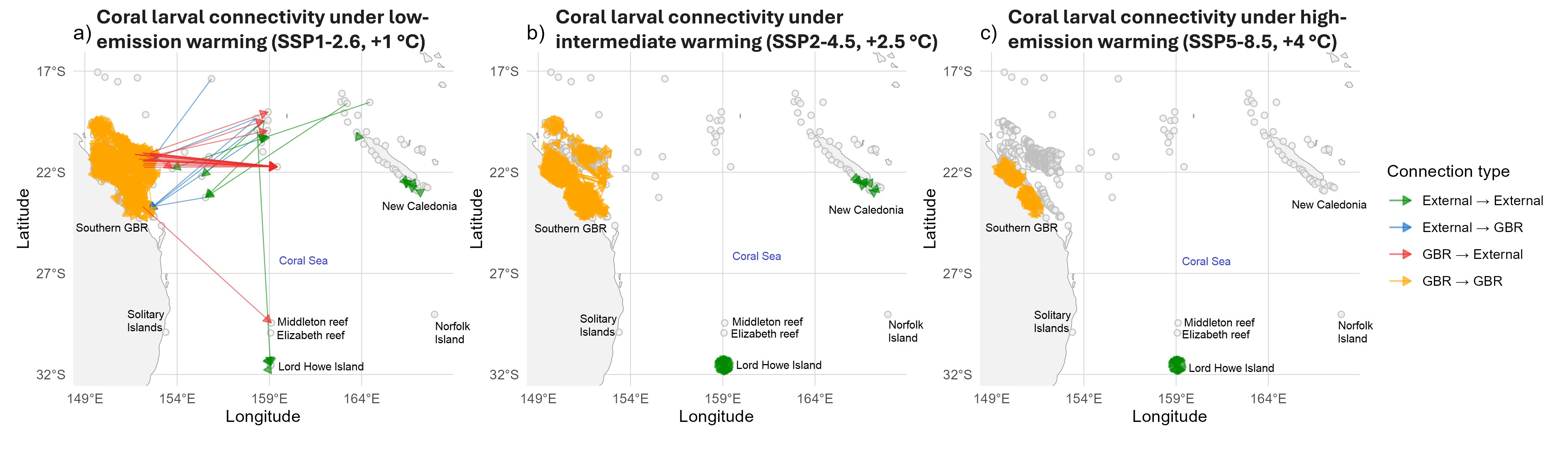
We created a computer model tracking how coral larvae travel between 850 reefs from the southern Great Barrier Reef to New Caledonia and Lord Howe Island over 13 years. We modeled two coral types –fast-growing branching corals and slow-growing boulder-shaped-corals –and simulated what would happen under three warming scenarios matching climate predictions through 2100.
Our results reveal a troubling mismatch: the reefs we have identified as climate-resistant (harboring heat-tolerant corals) are poorly connected to other reefs, meaning their valuable genes won’t spread easily. Meanwhile, the reefs acting as major “larval suppliers” are kept cool by natural ocean currents, but their corals may not be ready for the extreme temperatures predicted for the future.
Under warming scenarios, connections collapsed dramatically, losing 67% at +1°C, 83% at +2.5°C, and 99% at +4°C. But Lord Howe Island, Australia’s southernmost coral reef, showed remarkable persistence. Its cooler waters may allow it to maintain connections when tropical reefs fail, potentially serving as a lifeboat for coral biodiversity.
These findings suggest we need to rethink coral reef protection. Rather than managing each protected area separately, managers should coordinate across international boundaries to protect the “stepping-stone” reefs in the Coral Sea that connect distant systems, and prioritize Lord Howe Island as a climate refuge reserve—it may be one of the last coral reef systems standing in this region by 2100.
This is a Plain Language Summary discussing a recently-published article in Journal of Applied Ecology. Find the full article here.

