Prescribed burning is the act of intentionally burning an ecosystem and is used in fire-prone regions around the world to manage fuel loads or conserve biodiversity. Some ecosystems experience fires that are too hot or occur too frequently, while other areas suffer from a lack of fire. Prescribed burning at the right intensity and frequency can help minimise the risk of wildfire while also promoting regeneration of species which evolved under a regime of recurrent fire.
When fire is re-introduced after a long period of fire exclusion, invasive plant species can complicate prescribed burning by either intensifying or suppressing fire. In the early stages or re-introducing fire, cool burning at higher-than-normal frequencies, such as annually or every second year, can limit plant invasion and promote native biodiversity. This assumes, however, that soil seedbanks are not depleted after a single fire and remain sufficient to re-populate an area before fire is re-applied.
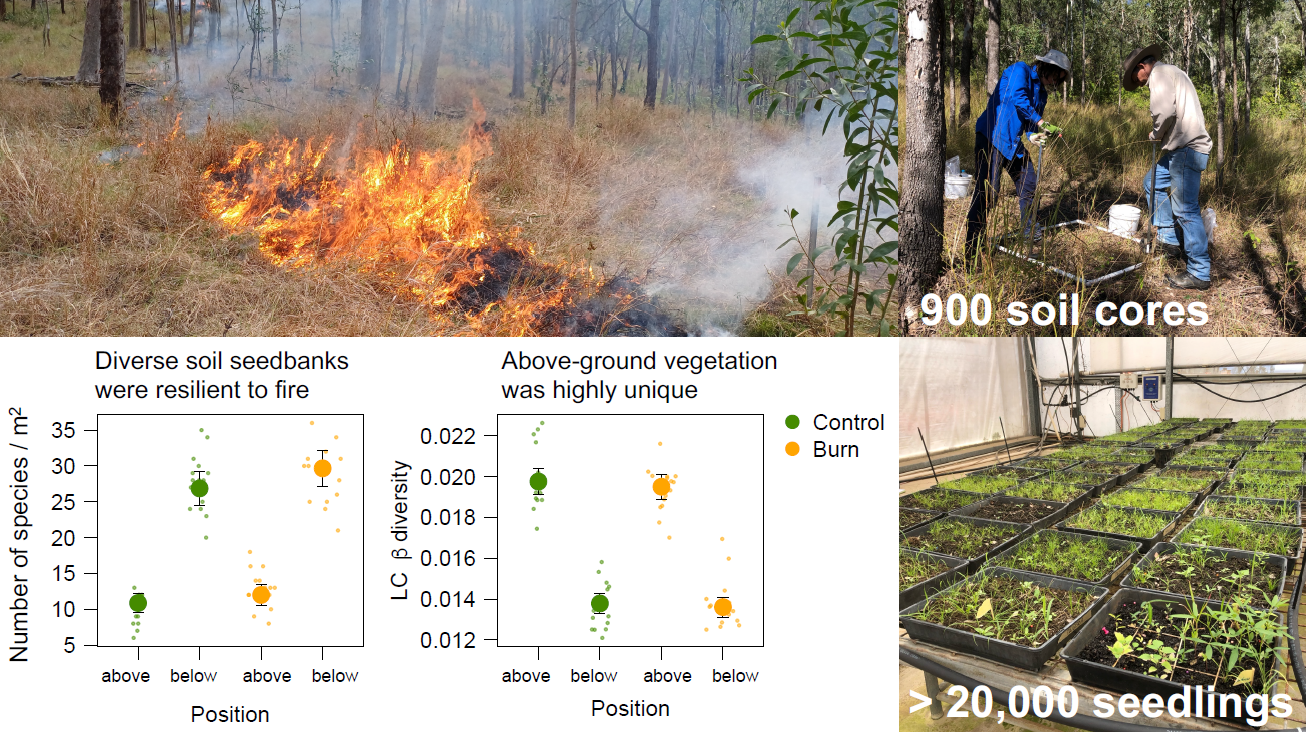
We examined soil seedbanks nine months after reintroducing low-intensity fire in a subtropical grassy woodland in southeast Queensland, Australia. We analysed 30 local plant communities and examined how diverse and unique each plant community was, relative to the above-ground vegetation. The soil seedbank was monitored during a 5-month glasshouse emergence trial, in which we identified over 20,000 individual seedlings.
Soil seedbanks were incredibly diverse, holding twice as many species as the above-ground vegetation. For example, if we found 11 species per square metre at one location, there would be an average of 27 species underground in the soil seedbank. This high biodiversity was not affected by fire, meaning that seedbanks hold a rich reservoir of biodiversity for post-fire regeneration. A second fire in the near term is unlikely to negatively impact biodiversity. Above-ground vegetation tended to be highly unique, while soil seedbanks were more similar from site to site. Management activities which diminish above-ground plant diversity (such as over grazing or conversion to forest) will impact biodiversity at larger spatial scales, while localised disruptions are less likely to negatively impact soil seedbanks.
This is a Plain Language Summary discussing a recently-published article in Journal of Applied Ecology. Find the full article here.

