
Afforestation is widely used to restore degraded land and improve soil health, but not all planting approaches deliver the same ecological benefits. Soils perform many important functions, including supplying nutrients to plants, supporting microbial activity, decomposing organic matter and maintaining nutrient cycling. However, how different afforestation strategies influence these functions together remains poorly understood.
In this study, we compared four land-use types in tropical China: bare land, a Eucalyptus monoculture plantation, a mixed-species secondary forest and an old-growth natural forest. We found that afforestation greatly improved soil multifunctionality, and that mixed-species plantations performed better than single-species plantations. This improvement was likely supported by more diverse and functionally active soil microbial communities.
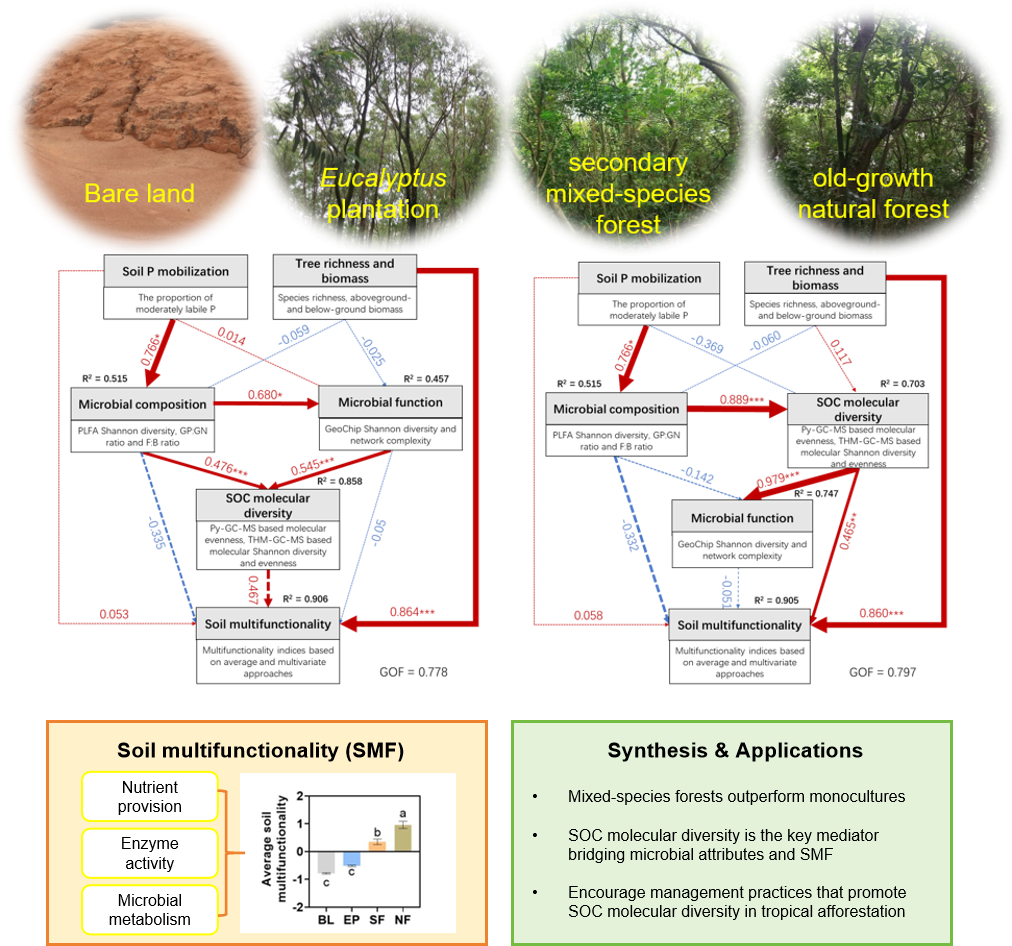
Our results further show that the diversity of soil organic carbon molecules plays a key role in linking microbial attributes with soil multifunctionality. After afforestation, especially mixed-species afforestation, soils contained a wider variety of organic carbon molecules. This greater molecular diversity may help support decomposition, nutrient release and microbial processes, thereby allowing forest soils to perform more functions.
These findings suggest that tropical restoration should focus not only on planting trees, but also on choosing appropriate tree combinations. Prioritizing mixed-species afforestation and promoting managements that faciliate diversification of soil organic carbon molecules can help maximize soil health and ecosystem functioning in restored forests.
This is a Plain Language Summary discussing a recently-published article in Journal of Applied Ecology. Find the full article here.
It is also available in Chinese here.

