
We sought to understand whether adding many nest boxes for barn owls, a common way to help control rodents on farms, might have hidden drawbacks. While more nest boxes can boost owl numbers, it is not always clear if this improves the survival of young birds. We studied barn owls in northern Israel using small electronic tags that recorded each time a bird entered a nest box. This allowed us to track a behavior called “nest switching,” in which young owls leave their own nests and visit other nests that still contain chicks.
We found that nest switching was surprisingly common. About 13% of young owls visited other nests, and more than half of the monitored nests were visited by at least one outsider. Nest switching was more frequent in areas with many nearby nests and when the chicks in the host nest were younger. We then investigated whether this behavior affects breeding success.
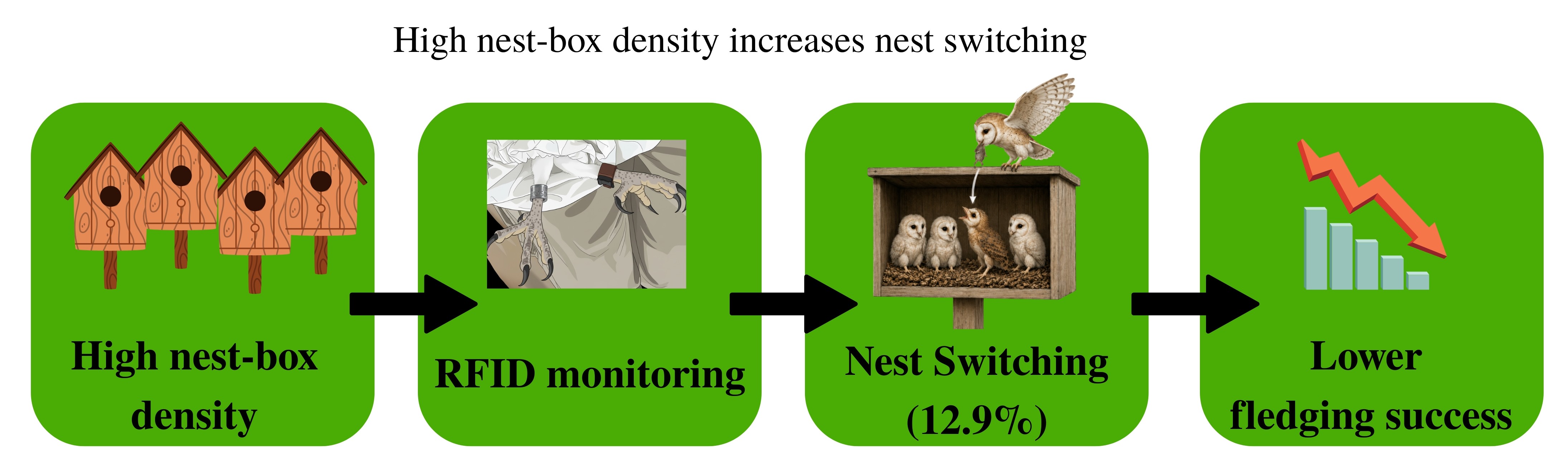
We discovered that the total number of chicks raised in a nest did not change with nest switching. However, each chick was less likely to survive to fledging when nest switching was more frequent. This shows that looking only at the number of chicks produced can miss important survival costs. Parents fed nests more often when they had more chicks, but this did not remove the negative association between nest switching and chick survival.
Our results show that increasing the number of nest boxes can unintentionally lead to more competition among young birds. This can reduce survival even when overall productivity appears high. We suggest that nest-box programs should consider not only how many birds are produced but also how many survive. Avoiding very high local nest densities may improve long-term success.

