
Hunting can affect bird populations both by reducing their numbers and by changing how they behave. In Europe, many bird species that can legally be hunted are already in poor conservation status. Under the EU Birds Directive, hunting these species should only take place as part of a management plan that supports their recovery. To do this, it is important to know whether current hunting levels are sustainable.
We evaluated the sustainability of hunting for 27 migratory bird species with unfavourable conservation status across the European Union. Using population models, we compared the number of birds currently harvested with the estimated number that could be taken without threatening population recovery. We also tested different management objectives, ranging from more cautious to more permissive approaches.
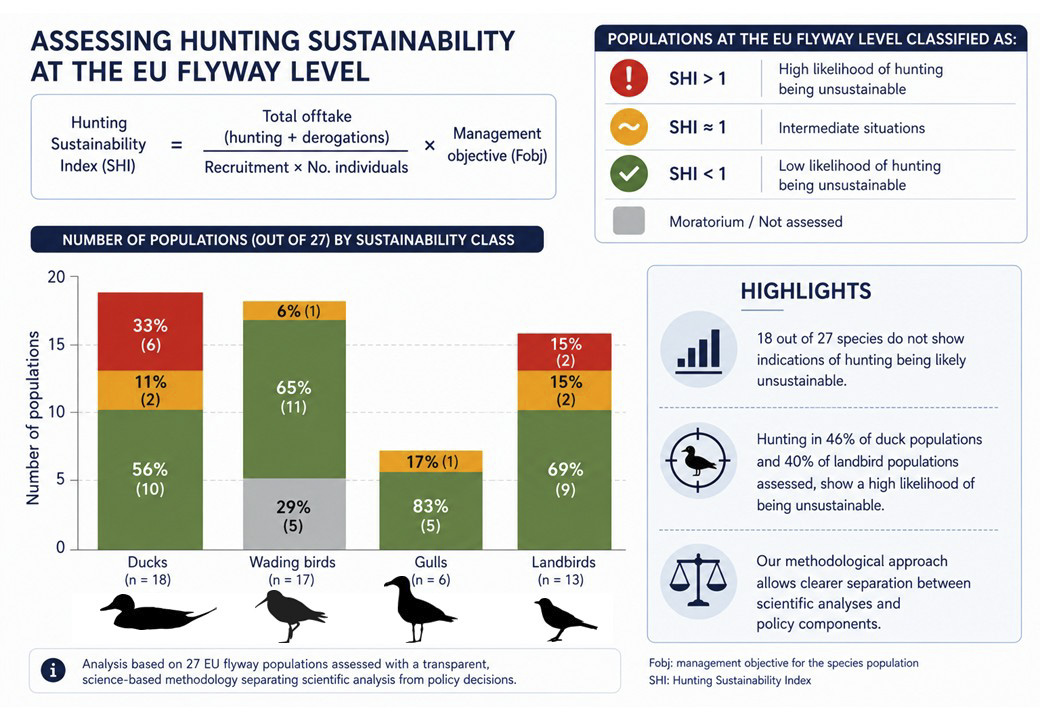
Our results suggest that current hunting levels are likely to be unsustainable for at least one population in six species, including five duck species and one landbird. Three additional species may also be experiencing unsustainable harvest levels. For some duck species, however, recent population trends do not match the model results, indicating that better information on population size, hunting levels, and migration routes is needed.
This study identifies the bird species and populations most at risk from overharvesting in the EU. The findings can help guide conservation and hunting management decisions, support compliance with the EU Birds Directive, and provide an objective scientific basis for discussions among policymakers, hunters, and conservation organisations about management priorities.

