
Fishing nets set on the seafloor accidentally catch and kill thousands of small whales and dolphins every year. This accidental capture, known as bycatch, is one of the biggest human-caused threats to these animals. In the Baltic Sea, harbour porpoises are particularly affected by bycatch in fishing nets. Although many studies have investigated how well porpoises can detect nets, we still know surprisingly little about what actually happens when a porpoise encounters a net in the wild.
To better understand this problem, we carried out the first field experiment combining drone observations with underwater acoustic recordings to study how harbour porpoises behave around a fishing net in their natural habitat. We used a specially designed dummy net that allowed us to observe interactions safely. We tested the dummy net both on its own and together with a sound-emitting warning device intended to alert porpoises to the presence of the net.
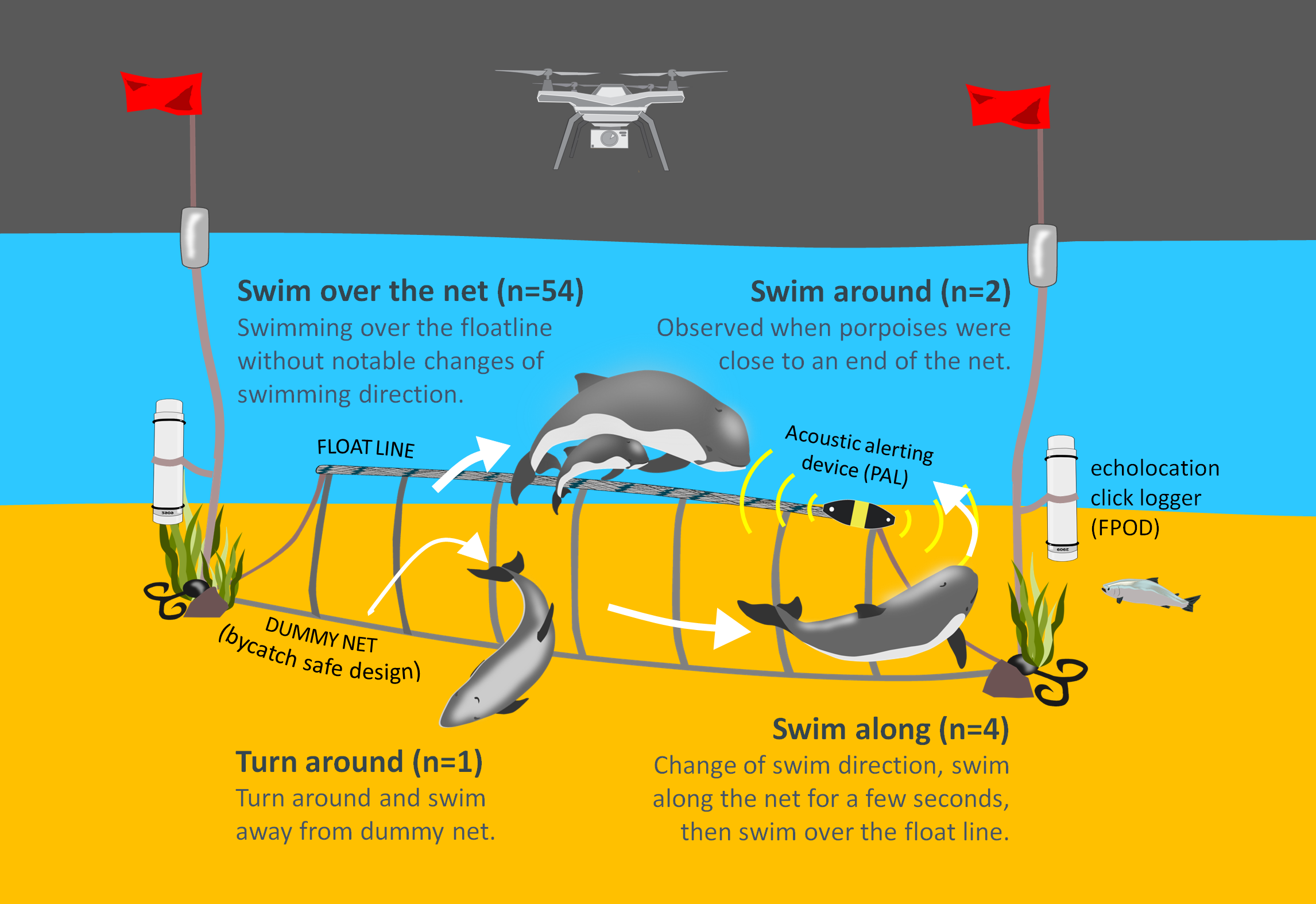
We observed porpoises swimming towards the net, swimming over it, around it, and on one occasion turning around and swimming away. The most observed observation was porpoises, including mothers with calves, crossing safely by swimming over the net. Overall, neither the net nor the warning device caused major changes in swimming speed, breathing behaviour, or sound production. However, porpoises consistently avoided direct contact with the net, even when they reacted only a few metres away.
Our findings suggest that harbour porpoises are generally able to avoid fishing nets. This indicates that bycatch may not simply result from an inability to perceive the net, but be caused by distraction. These new insights can help guide the development of future bycatch mitigation measures, highlighting the potential value of approaches that increase porpoises awareness of nets.

