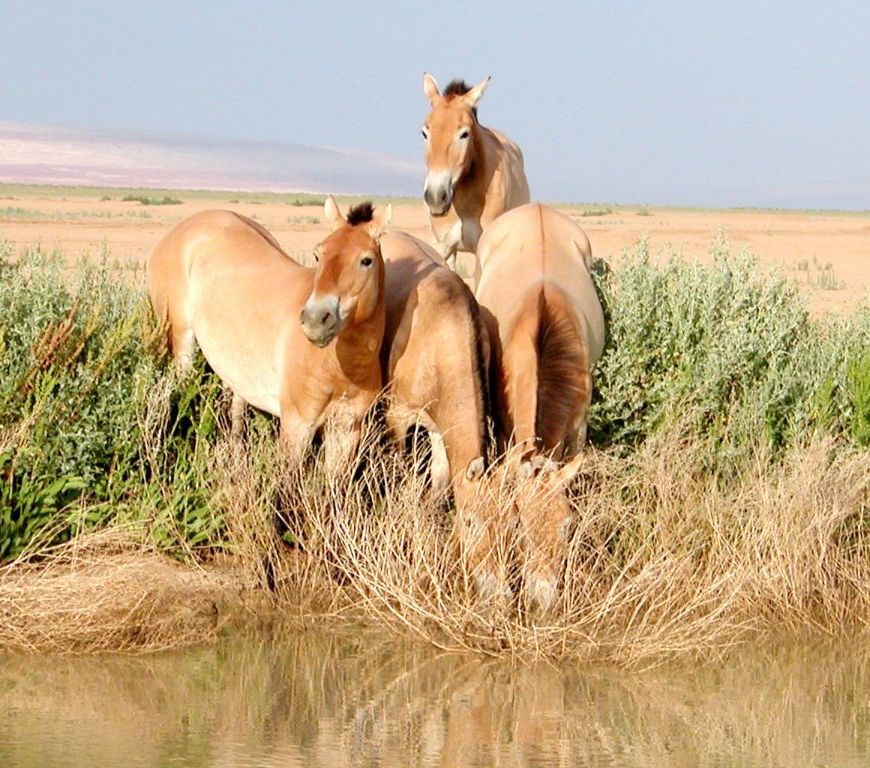
Qing Cao: Coexistence between Przewalski’s horse and Asiatic wild ass in the desert

Shortlisted for the 2025 Southwood Prize About the research Overview Our paper explores how two closely related wild equids—Przewalski’s horses and Asiatic wild asses—coexist in the extremely water-limited deserts of the Dzungarian Gobi. Classical niche theory would predict competitive exclusion under such scarcity, especially since horses are more water-dependent. By combining controlled water-use experiments with long-term camera trap data, we asked: what defines their fundamental water … Continue reading Qing Cao: Coexistence between Przewalski’s horse and Asiatic wild ass in the desert

Grizzly bears and wolves avoid busy hiking trails more than previously thought

Peter Thompson explains how, alongside colleagues, the spatial distribution and interactions of grizzly bears (Ursus arctos), grey wolves (Canis lupus), and humans within the central Canadian Rocky Mountains were monitored and assessed in their latest study. Human recreation and wildlife The Bow River Valley in Alberta, Canada is a global hotspot for outdoor recreation, attracting millions of visitors annually to enjoy the spectacular landscapes of … Continue reading Grizzly bears and wolves avoid busy hiking trails more than previously thought

Community-level responses of African carnivores to prescribed burning

Fires are common in many ecosystems world-wide, and are frequently used as a management tool. Using South African carnivores as their focal community, Laura C. Gigliotti and colleagues explore the relative changes in carnivore intensity of use in post-fire landscapes associated with hypothesized changes in prey availability and top-down suppression. Prescribed burning is a common form of habitat management and assessing wildlife responses to burning is … Continue reading Community-level responses of African carnivores to prescribed burning