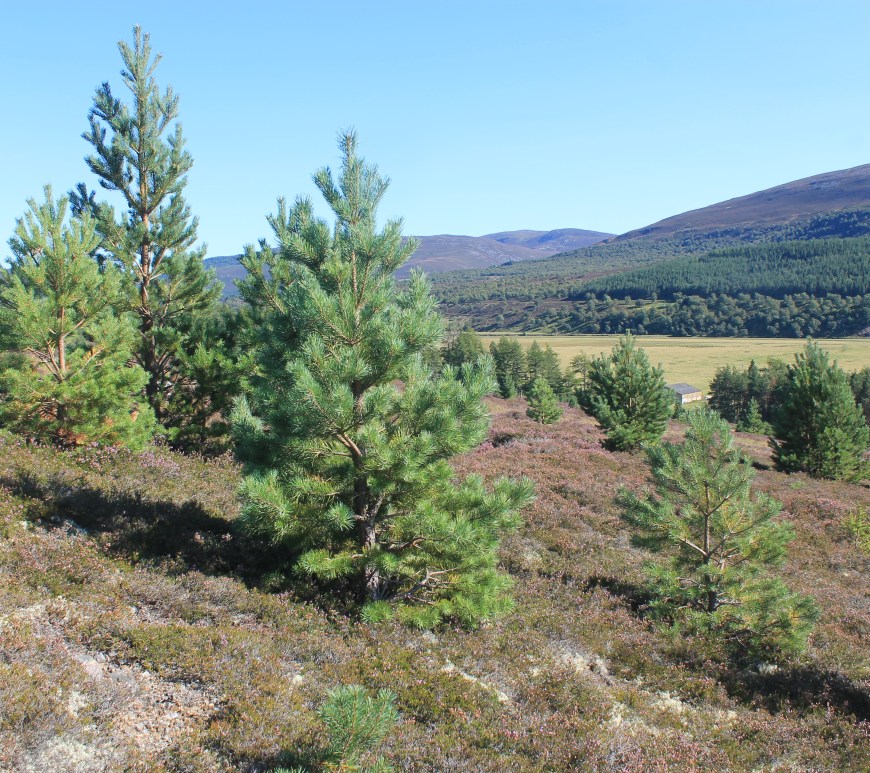
Project to restore and expand Scotland’s ancient forests provides a boost to moth biodiversity

Patrick Cook and his team share their experience investigating how moths respond to a landscape-scale woodland expansion project at Mar Lodge Estate in the Scottish Highlands. Background Upland landscapes in Scotland have a low cover of native woodland yet provides an excellent opportunity to expand woodland cover for biodiversity. For instance, native pinewood now covers less than 18,000 hectares in 84 small areas and an … Continue reading Project to restore and expand Scotland’s ancient forests provides a boost to moth biodiversity

Applying remote sensing techniques to wide-scale vegetation inventories

Feature image © InnoTech Alberta Originally posted and adapted from The Alberta Biodiversity Monitoring Institute Blog. Author Sydney Toni describes their latest study that explores a more cost-effective way of using remote sensing to better understand landscapes at larger scale for habitat monitoring and management. Ideally, the information we collect to manage wildlife habitat is many things: high-resolution, consistent and covering all areas of interest. The … Continue reading Applying remote sensing techniques to wide-scale vegetation inventories

Editor’s Choice 58:9 Identifying a pathway towards recovery for depleted wild Pacific salmon populations in a large watershed under multiple stressors

Associate Editor, Hedley Grantham, introduces this month’s Editor’s Choice article by Lia Chalifour and colleagues, which evaluates the potential benefits of 14 management strategies on 19 conservation units of the five Pacific salmon species in the lower Fraser River, British Columbia, Canada. Salmon are an iconic and globally recognisable species. In the Northeast Pacific they are also an important commercial and recreational fish species with … Continue reading Editor’s Choice 58:9 Identifying a pathway towards recovery for depleted wild Pacific salmon populations in a large watershed under multiple stressors

The road to recovery: New research identifies priority actions for lower Fraser River salmon

In their latest research, Dr Lia Chalifour and colleagues evaluate the potential benefits of 14 management strategies – spanning fisheries, habitat, pollution, pathogens, hatcheries and predation management dimensions – on 19 genetically and ecologically distinct populations of the five Pacific salmon species in the lower Fraser River, British Columbia, Canada. Fisheries closures in British Columbia have become the norm, with ‘good years’ for returning stocks … Continue reading The road to recovery: New research identifies priority actions for lower Fraser River salmon

Behind the cover 2:3 – Sand addition augments gharial nesting in degrading aquatic habitats

Gaurav Vashistha and colleagues describe their latest research attempting to reverse the observed decline in gharial nesting by improving nesting site conditions. Find out more about the research behind the cover of our latest issue. The gharial (Gavialis gangeticus) is a critically threatened, freshwater crocodile. Gharials nest in sandy substrates such as river banks and mid-river sand bars where females dig holes and lay their … Continue reading Behind the cover 2:3 – Sand addition augments gharial nesting in degrading aquatic habitats

Behind the cover 2:1 – Q&A with David O’Brien

In this Q&A, we find out more about the author and research: “A co‐development approach to conservation leads to informed habitat design and rapid establishment of amphibian communities” behind the cover image of our first issue of 2021. The research What’s your article about? Our article describes habitat creation and management for amphibians in economically active sites. We worked with farmers, foresters and a golf … Continue reading Behind the cover 2:1 – Q&A with David O’Brien

Integrating socio-economic and ecological data leads to better management recommendations

Comparing the effects of habitat fragmentation with those of human persecution on the Chilean güiña, Associate Editor, Kulbhushansingh Suryawanshi discusses the recent article, A spatially integrated framework for assessing socioecological drivers of carnivore decline by Gálvez et al. When trying to understand the distribution and abundanceof species, very often, ecological studies ignore the interactions these animals have with one of the most ubiquitous species on the planet, the human! … Continue reading Integrating socio-economic and ecological data leads to better management recommendations