Seed dispersal is essential for plant regeneration, especially on islands where many plants rely on animals to move seeds to safe places to survive. But because this process is hard to observe directly, conservation decisions often fall back on easier measures such as species counts. This can be misleading, because ecosystems are not only defined by the species they contain, but also by the relationships among them: which animals feed on which fruits, which plants they disperse, and how evenly this work is shared. A community can therefore look “rich” while seed dispersal becomes more fragile, particularly if seed movement depends on just a few animals.
We studied seed dispersal on two small islands in the Seychelles with similar climate and natural history, but different management trajectories. One island has long-term strict protection, aimed at preventing new introductions and maintaining a historically informed community. The other island has a long history of human occupation and species introductions, leading to a more human-diversified mix of plants and animals.
We assembled evidence of seed dispersal by identifying intact seeds in animal droppings. Using these records, we compared how seed dispersal was organised under different management histories, including how diverse the plant–animal seed dispersal relationships were, which species mattered most for the overall pattern, and whether shared species played the same roles on both islands.
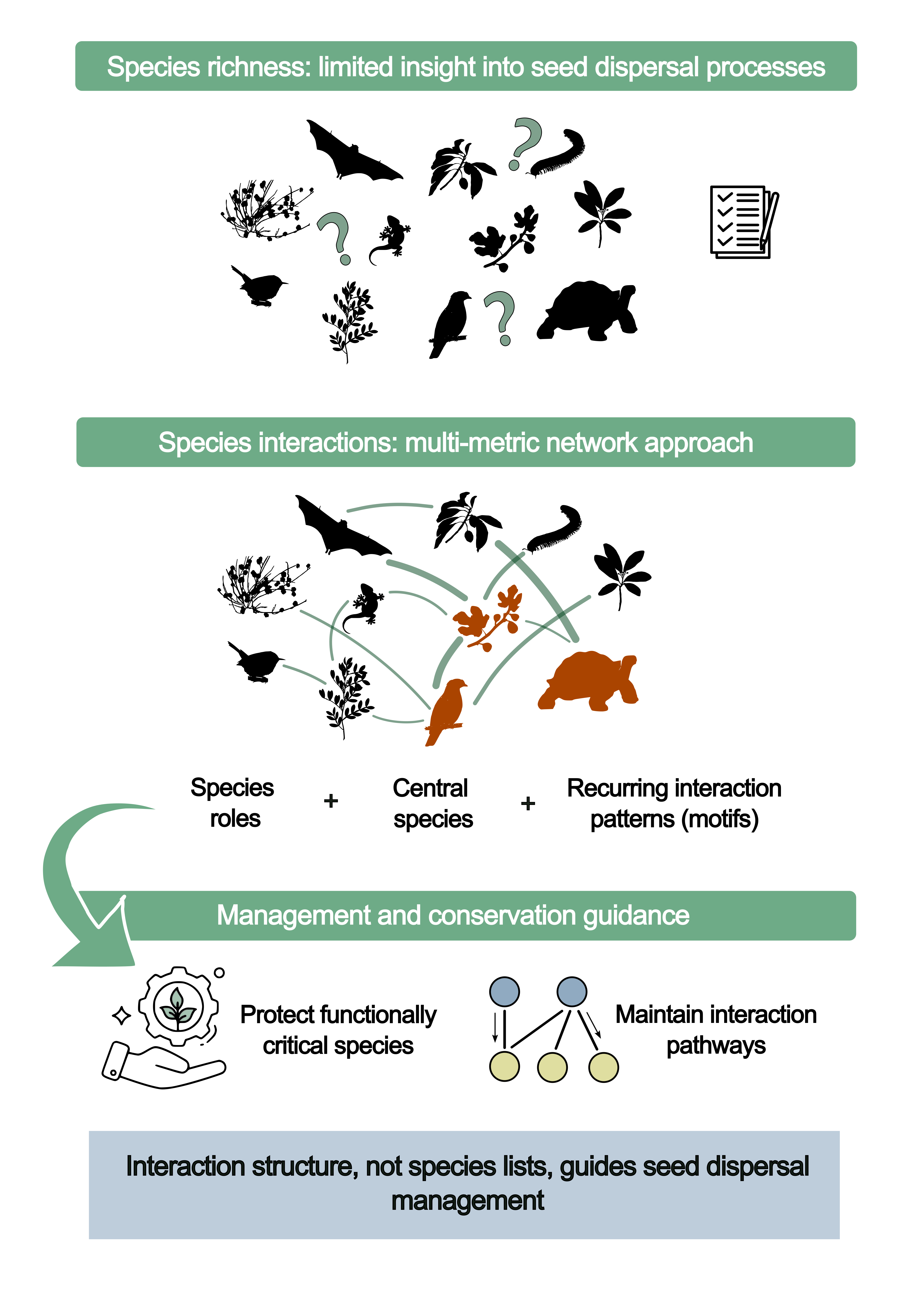
A striking result was that species shared between islands did not “do the same job” in both places. On the human-diversified island, seed dispersal tended to revolve around a small number of central dispersers, while many other species played minor roles. On the strictly protected island, seed dispersal was more evenly spread, giving plants more alternative routes for seed movement.
This has practical implications. Management can produce contrasting seed dispersal regimes even under similar environmental conditions. A diversified community may generate more interactions, but still be structurally fragile if many plants depend on a few key animals. By mapping these relationships, not just counting species, managers can better anticipate risk, identify critical dispersers, and design actions that keep plant regeneration and ecosystems functioning in the long term.
This is a Plain Language Summary discussing a recently-published article in Journal of Applied Ecology. Find the full article here.

