Every year, vehicle collisions with deer and wild pigs cause billions of dollars in damages and injure thousands of drivers. Most collisions occur at night when the animals are more active and when it is more difficult for drivers to see. Recent research has found that illuminating the front end of the vehicle with a lightbar can reduce dangerous encounters with deer, and newer light emitting diode (LED) headlights may affect wildlife behavior differently than older, halogen headlights. However, it is unclear how these vehicle lighting systems impact wildlife behavior in real-world settings.
In this study, we tested how headlight type (LED vs. halogen) and the use of a rear-facing lightbar impacted behavior of free-ranging deer and wild pigs in response to an approaching vehicle at night. We collected data over two years using thermal cameras and GPS while driving more than 7,000 km.
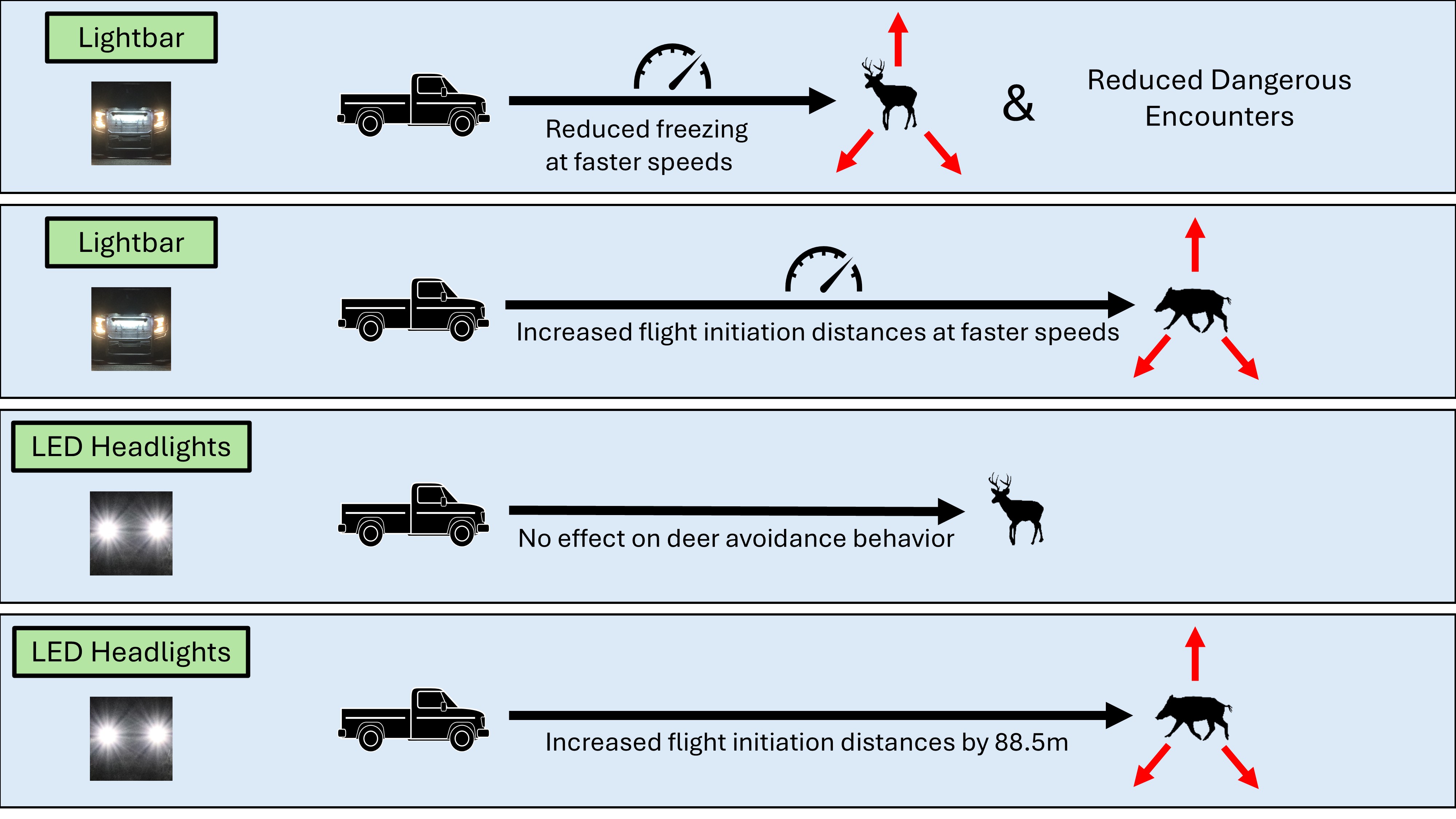
We found that LED headlights did not change deer responses but led to wild pigs fleeing from the vehicle at longer distances. At faster vehicle speeds, increased vehicle illumination with a lightbar reduced dangerous deer behaviors like “freezing in headlights” and last second responses, while also causing wild pigs to move away from the road earlier.
Overall, our findings suggest that vehicle lighting can impact wildlife responses to approaching vehicles at night. LED headlights had neutral to beneficial effects on deer and wild pigs, suggesting they can reduce collisions, given that they allow drivers to see farther. Increased frontal vehicle illumination resulted in safer responses by both species. Taken together, our findings suggest that simple vehicle modifications can result in large economic and driver safety benefits when applied broadly.

