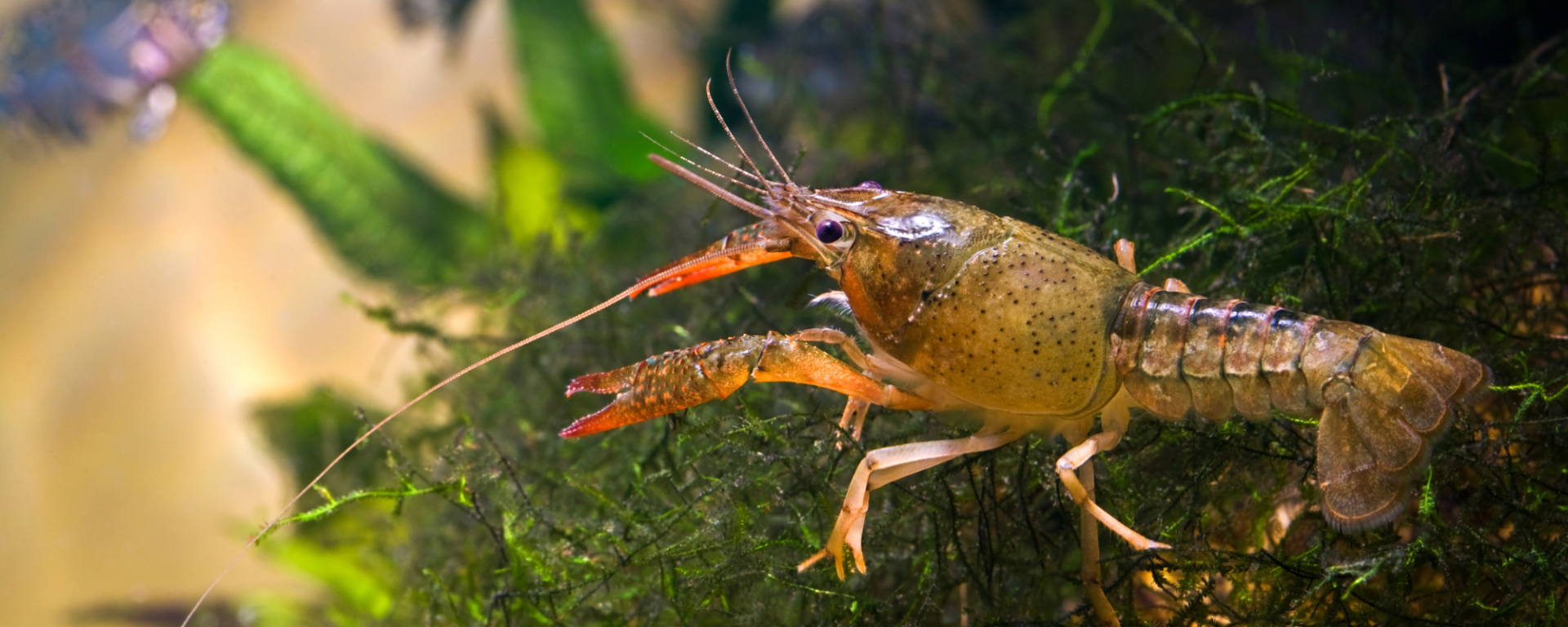
Moscovitz et al. share their experience comparing between predation preferences of a prawn and a crayfish over four species of snails which are aquacultural pests, explaining the observed preferences – or lack thereof – by quantifying snail traits.
Freshwater snails are tiny – but in aquaculture systems, they loom large. In fishponds around the world, snails act as intermediate hosts for parasitic trematodes that harm farmed fish by causing diseases, damaging gills, skin, eyes and more. Infected fish exhibit reduced growth and increased mortality, resulting in financial losses for farmers.
The most common way to reduce parasite-induced diseases, is to by snail-control, i.e., reduce snail abundances in the fishponds. Recently the use of non-GMO monosex populations of the tropical giant freshwater prawn, Macrobrachium rosenbergii, as a voracious biocontrol agent against snails in aquacultural fishponds, has been on the rise. Monosex technology ensures that the entire prawn population is either all-male, or all-female. In areas of the world where the prawn is not endemic, or is not used in mixed-sex aquaculture populations, it is an excellent, ecologically sound solution, since monosex populations cannot reproduce. As practiced in an aquacultural region in Israel since 2017 – the prawns predate on the snails, and the fish health improves.
More recently, advances in monosex technology have expanded to another crustacean: the Australian redclaw crayfish, Cherax quadricarinatus. All-female populations are now feasible, opening the door to their potential use as a sustainable biocontrol agent as well.
Both crustaceans are valuable aquaculture products in their own right. But should farmers battling snails prefer prawns or crayfish? We set out to test whether one predator outperforms the other. Click here to read our recent research, Moscovitz et al., 2026.
Not all snail prey are created equal
Fishponds are often dominated by a suite of disease transmitting, sometimes invasive, freshwater snails, when in our study region they include: Melanoides tuberculata,Thiara scabra, Tarebia granifera and Haita acuta. These species vary widely in external morphology. Some have thick, ornamented shells; others have smooth, thin shells that should be easier to crack. Because handling time – the time a predator spends subduing and consuming prey – often influences prey choice, we expected differences in snail morphology to shape the predator’s feeding behavior.
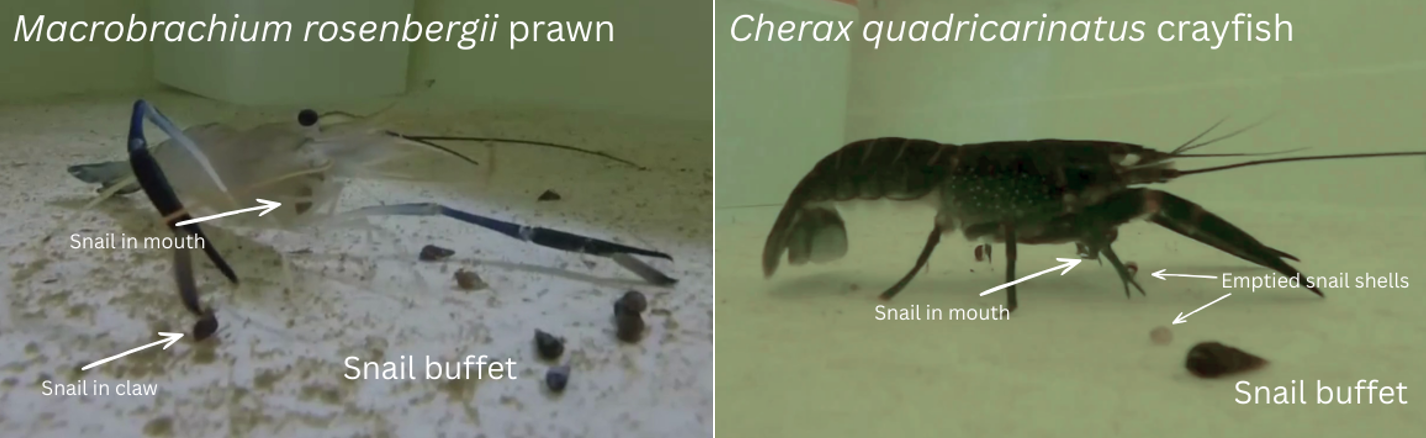
Cafeteria experiment
We conducted a food-choice, or “snail cafeteria”, experiment to understand if any of the predators prefer a snail species over another. Each prawn or crayfish was presented with equal numbers of all four snail species in an experimental tank and observed over one week.
We found that the prawn was selective (picky eater) – it clearly preferred first the thin-shelled snail, then made its way towards the thick-shelled and spiny snail. The crayfish, however, exhibited opportunistic behavior, and resembled a teenager in front of a full fridge – it just ate whatever snail it encountered.
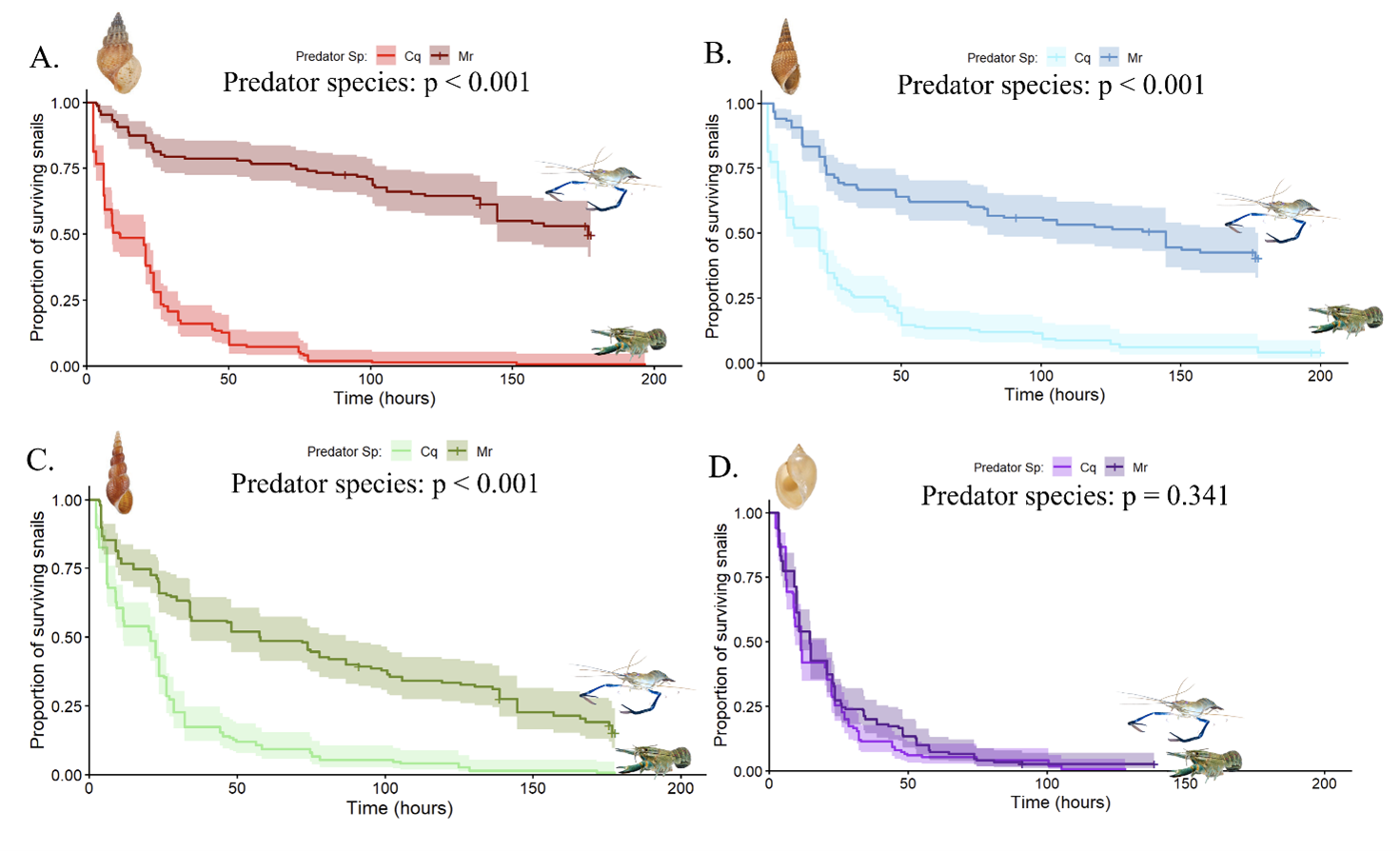
Explaining preferences with numbers – measuring the most and least preferred snails
To understand why prawns were selective with numbers, we quantified shell characteristics of the two extremes – the prawns least and most preferred snails. Snail shell thickness of its most preferred snail, the thin-shelled H. acuta, was 2.5-times thinner than that of its least preferred Thiara scabra. Mechanical compression tests revealed that breaking Thiara scabra required roughly 8 Newtons more force than breaking H. acuta (don’t worry, the snails were euthanized in ice). From an energy maximization standpoint, prawns appear to be making a “cost-benefit calculation” – favouring prey that yields more energy for less effort. The crayfish, meanwhile, seems less constrained by shell strength.
Implications for aquaculture and management
When deployed thoughtfully, both could provide multiple ecosystem services, including reducing fish disease risk, lowering reliance on chemical pesticides, and offering farmers additional harvestable protein, tailored to their fishpond and local market preferences, in a win-win-win scenario. Biocontrol doesn’t have to be a trade-off between conservation and production. With the right species and careful management, it can enhance both.

