Welcome to our new mentees 2020

We’re pleased to welcome nine new Associate Editor Mentees to the Journal of Applied Ecology Editorial Board. Get to know the newest members of our journal team. Maxime Damien, Manitoba University, Canada Maxime researches plant-insect interactions, from individual insect life history to community ecology, in a way that looks at how plants influence several aspects of arthropod biology, including evolutional trajectories, population dynamics and community … Continue reading Welcome to our new mentees 2020

Expanding communication and inclusion in applied ecology: lessons from the past and the path ahead

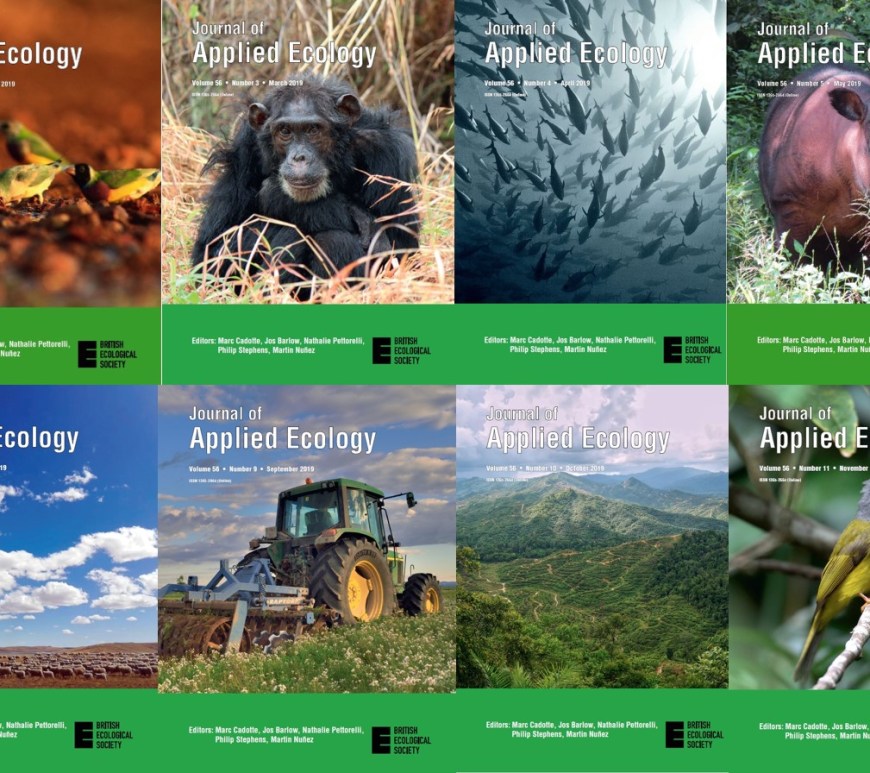
Journal of Applied Ecology’s outgoing and incoming Executive Editors, Marc Cadotte and Jos Barlow, take stock of the growth of the journal and how applied ecology has developed as a discipline in the past decade. They also look forward to innovative new projects and publications aiming to further support ecological researchers and practitioners.  Applied ecological research has never before been more germane to the management … Continue reading Expanding communication and inclusion in applied ecology: lessons from the past and the path ahead

Shortlist announced for Southwood Prize early career researcher award

Each year Journal of Applied Ecology awards the Southwood Prize to the best paper in the journal by an author at the start of their career. Today we present the shortlisted papers for this year’s award, based on the previous (56th) volume of the journal. The winner will be selected in the coming weeks so watch this space for future announcements. This year’s shortlisted candidates … Continue reading Shortlist announced for Southwood Prize early career researcher award

Improving soil fertility in cocoa agroforests using the most suitable shade tree species

Can leaf quality explain the influence of shade tree species on the fertility of cocoa farms? Marie Sauvadet and colleagues summarise their recent research. Cocoa, a major commodity worldwide, is largely produced by smallholder farms in developing countries. With limited access to synthetic fertilisers and pesticides, smallhold farmers traditionally lean on cocoa ecology to ensure their harvest thorough the years. Cocoa naturally grows under the … Continue reading Improving soil fertility in cocoa agroforests using the most suitable shade tree species

Let’s not turn big horns into little horns

In their new research, Testing the importance of harvest refuges for phenotypic rescue of trophy‐hunted populations, Poisson and colleagues explain why closing hunting seasons earlier could be vital to the future of bighorn sheep. This illustration by Benoît Leblanc summarises the key implications of their work. Read the full article, Testing the importance of harvest refuges for phenotypic rescue of trophy‐hunted populations in Journal of … Continue reading Let’s not turn big horns into little horns

Harvesting the benefits of the open science era in applied ecology  

From open data to preregistration of hypotheses, Erlend Nilsen and colleagues ask how can we make the most of open science in applied ecology? Take a look at this introduction to their recent Commentary and share your thoughts in the comments below. A world in rapid change The world around us is changing rapidly, and much of the research reported through Journal of Applied Ecology is, in … Continue reading Harvesting the benefits of the open science era in applied ecology  

A new approach for understanding the role of human-made structures in the North Sea

Hannah Tidbury and colleagues at the Centre for Environment, Fisheries and Aquaculture Science recently used social network analysis to aid marine spatial planning. Here Hannah explains a little more about the approach behind their work and what it means for oil and gas infrastructure. Connectivity between communities of organisms that live within marine environment is important because isolated communities are more vulnerable to extinction. Therefore, … Continue reading A new approach for understanding the role of human-made structures in the North Sea

Identifying hotspots of threats to marine megafauna

In newly published research, A framework for mapping the distribution of seabirds by integrating tracking, demography and phenology, Ana P. B. Carneiro et al. present a new framework aiming to tackle challenges of tracking seabird movement and ultimately improve bycatch mitigation measures. There is increased global awareness that our oceans are under threat. Marine megafauna such as seabirds, marine turtles, marine mammals, sharks and rays … Continue reading Identifying hotspots of threats to marine megafauna

Editor’s Choice 57:02 – Understanding anglers as spatially mobile human predators in freshwater landscapes

Using the example of a spatial recreational fishery for lake trout in northern Canada, Wilson et al. present an exciting analysis of how human behaviour and local ecological dynamics interact to shape landscape-level outcomes. Associate Editor, Robert Arlinghaus highlights why this article has been selected as an Editor’s Choice. The field of applied ecology is increasingly moving towards studies that integrate human behaviour and ecological … Continue reading Editor’s Choice 57:02 – Understanding anglers as spatially mobile human predators in freshwater landscapes