Taxonomic and functional diversity in Mediterranean pastures: Insights on the biodiversity – productivity trade-off

In this post Victor Rolo discusses his recent paper ‘Taxonomic and functional diversity in Mediterranean pastures: Insights on the biodiversity – productivity trade-off ‘ There is a shepherds’ saying in Spain that goes: “below a shrub, you can raise a lamb”. But, if that were true, why is the presence of semi-natural features perceived as a negative element for herbage productivity in grasslands? The answer … Continue reading Taxonomic and functional diversity in Mediterranean pastures: Insights on the biodiversity – productivity trade-off

Fine-scale salmon diversity sustains fisheries and supports food security of indigenous communities

A new study from Holly Nesbitt and Jonatahn Moore at Simon Fraser University shows that high biodiversity in salmon fisheries supports the food security of indigenous people. Salmon-folios Instead of analyzing market returns of different financial portfolios, this study examined indigenous fisheries with different “salmon-folios”. Like a well-balanced financial portfolio that can smooth market fluctuations, fisheries that caught a more diverse portfolio of salmon populations … Continue reading Fine-scale salmon diversity sustains fisheries and supports food security of indigenous communities

Not all herbivores are created equal – Characterizing population-level damage potential in migratory pests

In this post Gina Angelella discusses the recent paper from Sanford Eigenbrode and colleagues ‘Host-adapted aphid populations differ in their migratory patterns and capacity to colonize crops‘ When encountering a migratory insect such as a winged aphid, how confidently can one predict its origins and threat to crops? It is tricky enough to track the dispersal of a homogeneous species, but the addition of population-level … Continue reading Not all herbivores are created equal – Characterizing population-level damage potential in migratory pests

Maintaining diverse bee communities on farmland: the importance of floristic diversity

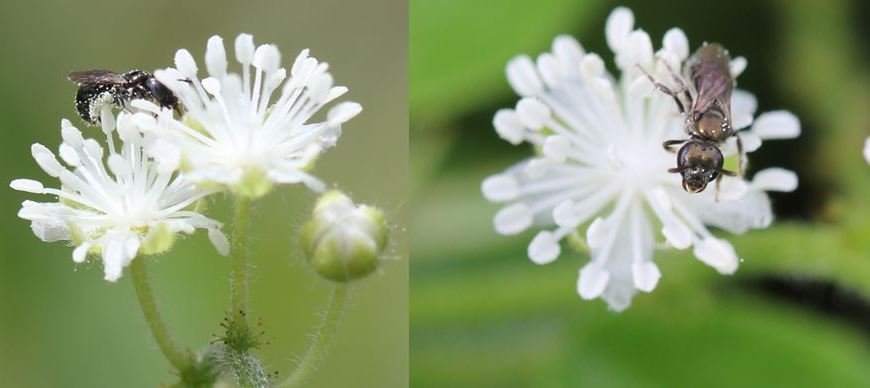
In this post Thomas Wood discusses his recent paper ‘Providing foraging resources for solitary bees on farmland: current schemes for pollinators benefit a limited suite of species‘ Farmland biodiversity was negatively affected across most European nations throughout the 20th century, predominantly due to a period of rapid agricultural intensification following the Second World War. Flowery hay meadows were ploughed up and herbicides, fertilisers and other … Continue reading Maintaining diverse bee communities on farmland: the importance of floristic diversity

Applied Ecology as a Global Enterprise

This post is from Journal of Applied Ecology’s newest Senior Editor Martin Nuñez. The BES’s recent response to the UK referendum reminding us that ecology is a global concern has offered me the ideal opportunity to introduce myself. I am Martin Nuñez, the newest Senior Editor of Journal of Applied Ecology. I am a researcher at CONICET, and Professor at Universidad Nacional del Comahue, in … Continue reading Applied Ecology as a Global Enterprise

60-year dataset provides first evidence of waterfowl resilience to wildfire in burning boreal forest

In this post Associate Editor Ayesha Tulloch discusses a paper she recently handled by Tyler L. Lewis, Joel A. Schmutz, Courtney L. Amundson, and Mark S. Lindberg,  ‘Waterfowl populations are resilient to immediate and lagged impacts of wildfires in the boreal forest‘ Across much of the fire-dependent ecosystems of the globe, fire at appropriate intervals and intensities is critical for stimulating growth and reproduction. However, … Continue reading 60-year dataset provides first evidence of waterfowl resilience to wildfire in burning boreal forest

Radar technology may help design raptor-proof wind farms in the future

In this post, Miguel Ferrer and Des Thompson discuss the recently published paper by Sergio Cabrera-Cruz and Rafael Villegas-Patraca ‘Response of migrating raptors to an increasing number of wind farms’ This study has for the first time used radar trajectories of more than 3.7 million migrant raptors, over six years, to measure responses to a wind farm. Essentially, in an experimental situation of pre- and … Continue reading Radar technology may help design raptor-proof wind farms in the future

The rise and fall of a simple solution

In this post Anna-Sara Liman discusses her recent paper ‘Predator refuges for conservation biological control in an intermediately disturbed system: the rise and fall of a simple solution‘ The first so called willow “energy forests” were planted in Sweden (and the UK) in the early nineties and represent among the first steps towards development of a bioenergy sector and a future bioeconomy. Willows are fast-growing … Continue reading The rise and fall of a simple solution

Beyond the Haze: Implications of the recent fires in Indonesia for tropical peatland research

This post was written by members of C-PEAT (Lydia Cole, Ian Lawson, Dave Beilman, Dan Charman and Zicheng Yu) to voice the group’s concern over the consequences of the recent extensive burning of Indonesia’s peatlands for science. C-PEAT (Carbon in Peat on Earth through Time) is a thematic group of PAGES (Past Global Changes), and had its inaugural meeting at Columbia University in New York, … Continue reading Beyond the Haze: Implications of the recent fires in Indonesia for tropical peatland research