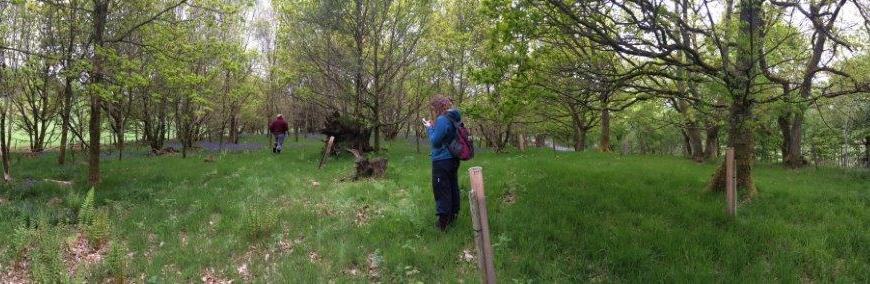
Women in applied ecology – tales from our editors (2 of 2)

What does it really mean to be a woman working in applied ecology? Thursday 8th March is International Women’s Day and Sunday 11th February 2018 was International Day of Women and Girls in Science. To celebrate this, some of our editors have shared  anecdotes highlighting their own challenges and triumphs, providing a snapshot of what it really means to be a woman in applied ecology. Select … Continue reading Women in applied ecology – tales from our editors (2 of 2)

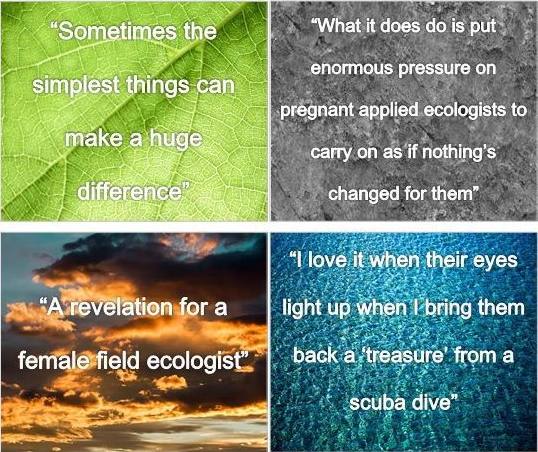
Women in applied ecology – tales from our editors (1 of 2)

What does it really mean to be a woman working in applied ecology? Thursday 8th March is International Women’s Day and Sunday 11th February 2018 was International Day of Women and Girls in Science. To celebrate this, some of our editors have shared  anecdotes highlighting their own challenges and triumphs, providing a snapshot of what it really means to be a woman in applied ecology. Select … Continue reading Women in applied ecology – tales from our editors (1 of 2)

Land use change and the interplay between functional and phylogenetic diversity in tropical forest birds

Philip Chapman comments on recent article, Contrasting impacts of land-use change on phylogenetic and functional diversity of tropical forest birds. It is increasingly recognised that biodiversity conservation needs to look beyond the goal of preserving species richness, to maintaining healthy functioning ecosystems and their evolutionary resilience in the face of environmental change. Species vary in evolutionary distinctness and the uniqueness of traits contributing to key ecological … Continue reading Land use change and the interplay between functional and phylogenetic diversity in tropical forest birds

Integrating socio-economic and ecological data leads to better management recommendations

Comparing the effects of habitat fragmentation with those of human persecution on the Chilean güiña, Associate Editor, Kulbhushansingh Suryawanshi discusses the recent article, A spatially integrated framework for assessing socioecological drivers of carnivore decline by Gálvez et al. When trying to understand the distribution and abundanceof species, very often, ecological studies ignore the interactions these animals have with one of the most ubiquitous species on the planet, the human! … Continue reading Integrating socio-economic and ecological data leads to better management recommendations

Functional traits in agroecology: advancing description and prediction in agroecosystems

Our series of posts on the Special Feature, Functional traits in agroecology rounds up with a post from one of the series’ editors, Adam Martin. We’ve always thought “commentary” articles – particularly those that outline a vision for a future field of research – to be an interesting enigma in science. On one hand, many commentary-type articles have been undoubtedly influential and can be pointed … Continue reading Functional traits in agroecology: advancing description and prediction in agroecosystems

Biodiversity erosion in Brazil due to land use change: the case of grasslands

A new study by Ingmar R. Staude et al. calls for more restrictive policies around land use change in South Brazil’s grasslands. Read the full article, Local biodiversity erosion in south Brazilian grasslands under moderate levels of landscape habitat loss in Journal of Applied Ecology. Common perception of biodiversity in Brazil is mostly biased towards the exotic wilderness of Amazonia, to lush rainforests that harbor species … Continue reading Biodiversity erosion in Brazil due to land use change: the case of grasslands

Prioritising local habitat quality for woodland hoverflies

Kirsty Park and colleagues discuss the importance of habitat quality in restoration efforts. Read the full article, Local-scale attributes determine the suitability of woodland creation sites for Diptera in Journal of Applied Ecology. To benefit woodland-associated Diptera, and in particular hoverflies, woodland creation and restoration efforts should focus on ‘habitat quality’, in particular to ensure a diverse tree and understory vegetation structure. These are the findings … Continue reading Prioritising local habitat quality for woodland hoverflies

Functional traits represent a key nexus between scientific and local knowledge

Continuing our Special Feature series, Functional traits in agroecology, Marney Isaac comments on her paper, Farmer perception and utilization of leaf functional traits in managing agroecosystems. Using leaf functional traits to understand plant response to environmental change is well-established for research in a wide number of natural ecosystems, and now being more widely applied to agroecosystems. Yet, little is known about if, or how, farm managers … Continue reading Functional traits represent a key nexus between scientific and local knowledge

Increasing the conservation value of commercial stands – with Spanish translation

Can plantation forests offer conservation value to some species? Guadalupe Peralta comments on recent article Plant, herbivore and parasitoid community composition in native Nothofagaceae forests vs. exotic pine plantations.  The authors have also provided a Spanish translation of this post. ‘Conservation value of exotic plantation forests’ is a controversial idea. The term conservation value of plantation forests does not refer to the need to preserve plantation forests … Continue reading Increasing the conservation value of commercial stands – with Spanish translation

Ecological diversity metrics can teach us how to feed the world well

For the latest post in our Functional traits in agroecology series, Stephen Wood (The Nature Conservancy, Yale School of Forestry & Environmental Studies) highlights the importance of considering social and human, as well as ecological traits in agricultural systems. The full article, Nutritional functional trait diversity of crops in south-eastern Senegal is a part of a Special Feature in Journal of Applied Ecology. Crop yields have … Continue reading Ecological diversity metrics can teach us how to feed the world well