Cover stories: Gouldian opportunity

This month’s cover species, The Gouldian Finch (Erythrura gouldiae) is a threatened Australian granivorous bird and one of 637 Kimberley wildlife species allocated cost‐effective management priorities using the Priority Threat Management process. Here the photographer, Bruce Doran shares more images from his surprise encounter with this hard-to-spot bird. The photograph of the Gouldian Finches was the result of an incidental observation in the Victoria River … Continue reading Cover stories: Gouldian opportunity

Wind farms affect small birds too

Julia Gómez-Catasús explains the need for a 4.5km threshold between wind farms and small-sized birds, based on the recently published article, Wind farms affect the occurrence, abundance and population trends of small passerine birds: The case of the Dupont’s lark. Wind energy has experienced significant developments in recent decades, with China, United States, Germany, India and Spain being the main wind energy producers in the world. … Continue reading Wind farms affect small birds too

Forests in 3D

In this post Markus Eichhorn discusses his new article ‘Effects of deer on woodland structure revealed through terrestrial laser scanning‘ About the video: Three-dimensional reconstruction of a transect from Wyre Forest, an area of high deer density. The central 10 X 50 m plot is surrounded by a large number of points which were not used in the analyses. Survey apparatus is still visible. Points … Continue reading Forests in 3D

Density-dependence and marine bird populations: Are wind farm assessments precautionary?

In this post, Catharine Horswill discusses her paper ‘Density-dependence and marine bird populations: Are wind farm assessments precautionary?‘ “Just one thing would be enough to halt climate change, if clean energy became cheaper than coal, gas or oil, fossil fuel would simply stay in the ground”. Sir David Attenborough made this statement in support of the Global Apollo Program, an international initiative to increase the amount … Continue reading Density-dependence and marine bird populations: Are wind farm assessments precautionary?

Spotlight: How do renewable energy installations affect wildlife?

In the first post of its kind for The Applied Ecologist’s blog, Dr Lucy Wright, RSPB Principal Conservation Scientist, discusses five articles published in the latest issue of Journal of Applied Ecology, which have been grouped into a special profile on wildlife and renewable energy. All five papers are currently free to read online. Renewable energy is widely accepted to be a vital part of … Continue reading Spotlight: How do renewable energy installations affect wildlife?

Avian pest control in vineyards

In this post Michelle Harrison and Cristina Banks-Leite discuss a recent paper by Luc Barbaro and colleagues ‘Avian pest control in vineyards is driven by interactions between bird functional diversity and landscape heterogeneity‘. The global wine industry currently contributes roughly US$303 billion to the world’s economy (Plant and Food Research, 2013). Wine is a key export for many European countries such as Italy, France and … Continue reading Avian pest control in vineyards

The birds and the Bayes – new statistical approaches to modelling seabird flight heights

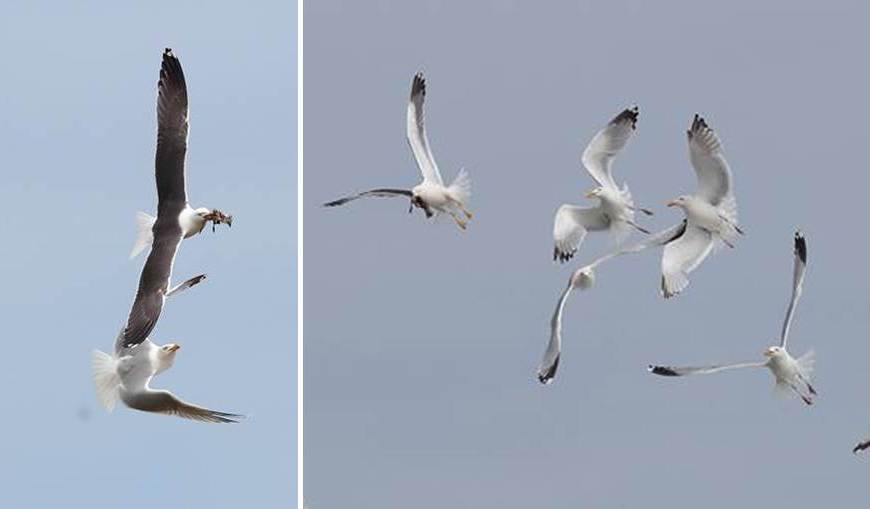
In this post Viola Ross-Smith discusses her recent paper ‘Modelling flight heights of lesser black-backed gulls and great skuas from GPS: A Bayesian approach‘. Although the need for renewable energy and its benefits are now widely recognised, this technology does not come without implications for biodiversity and the environment. For this reason, it’s important to assess and quantify the potential risks of renewables to wildlife … Continue reading The birds and the Bayes – new statistical approaches to modelling seabird flight heights

Radar technology may help design raptor-proof wind farms in the future

In this post, Miguel Ferrer and Des Thompson discuss the recently published paper by Sergio Cabrera-Cruz and Rafael Villegas-Patraca ‘Response of migrating raptors to an increasing number of wind farms’ This study has for the first time used radar trajectories of more than 3.7 million migrant raptors, over six years, to measure responses to a wind farm. Essentially, in an experimental situation of pre- and … Continue reading Radar technology may help design raptor-proof wind farms in the future

More accurate mapping of coastal wetlands is vital for their management and conservation

In this post, Associate Editor Nathalie Butt discusses a recent paper ‘Habitat mapping of coastal wetlands using expert knowledge and Earth Observation data’ by Maria Adamo, Cristina Tarantino, Valeria Tomaselli, Guiseppe Veronico, Harini Nagendra and Palma Blonda. Habitats at risk What do we usually think of when we hear ‘wetland’ or ‘coastal wetland’? A flat marshy area by the sea somewhere, perhaps with a bird … Continue reading More accurate mapping of coastal wetlands is vital for their management and conservation

Using maths to guide conservation law enforcement

In this post Kiran Dhanjal-Adams discusses her recent paper ‘Optimizing disturbance management for wildlife protection: the enforcement allocation problem’ For International Women’s Day, we asked Kiran about her career in science and the challenges and improvements she is seeing in STEM. You can read all of our posts for International Women’s Day here. Determining where and when to carry out enforcement patrols can be a … Continue reading Using maths to guide conservation law enforcement