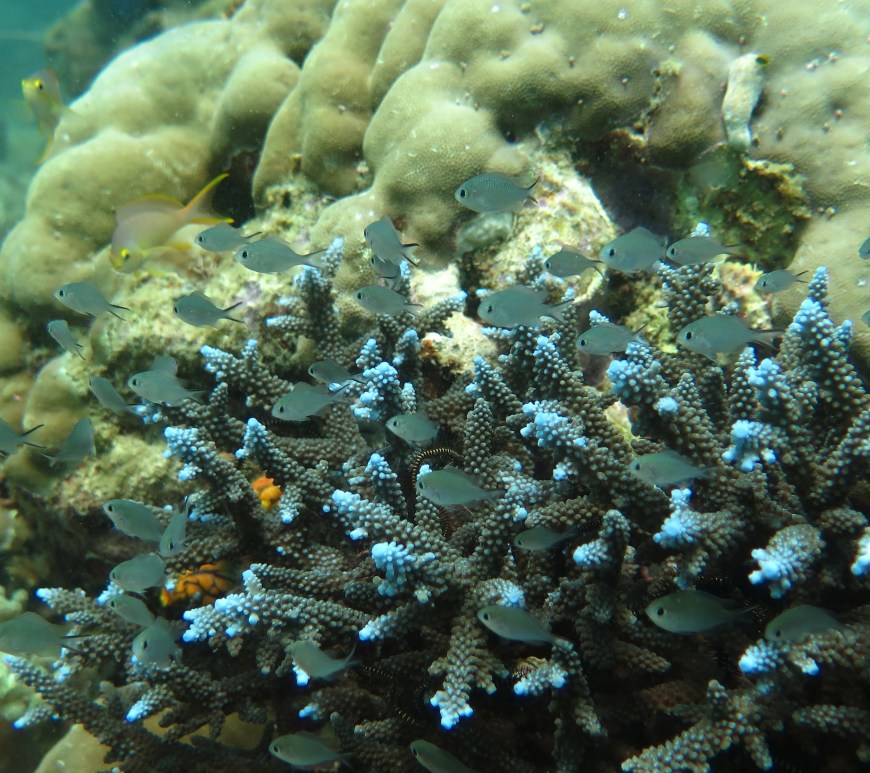
Spotlight: Addressing global fisheries management challenges in a changing world

From ecosystem productivity to economic benefits, issue 55:3 of Journal of Applied Ecology features a Spotlight on Fisheries management. Associate Editor, Stephanie Januchowski-Hartley brings the articles together and discusses the encouraging ways in which this research from temperate and tropical waters can inform management. Globally, hundreds of millions of people depend on marine and freshwater fisheries that are faced with mounting challenges and diverse issues … Continue reading Spotlight: Addressing global fisheries management challenges in a changing world

Tracking an apex marine predator – the shortfin mako shark

In this post Jeremy Vaudo and Mahmood Shivji discuss their article ‘Long-term satellite tracking reveals region-specific movements of a large pelagic predator, the shortfin mako shark, in the western North Atlantic Ocean’ In your paper you used satellite telemetry to investigate movements and seasonal distributions of shortfin mako sharks (Isurus oxyrinchus) in the western North Atlantic Ocean. What were the biggest challenges for this work? … Continue reading Tracking an apex marine predator – the shortfin mako shark

Fine-scale salmon diversity sustains fisheries and supports food security of indigenous communities

A new study from Holly Nesbitt and Jonatahn Moore at Simon Fraser University shows that high biodiversity in salmon fisheries supports the food security of indigenous people. Salmon-folios Instead of analyzing market returns of different financial portfolios, this study examined indigenous fisheries with different “salmon-folios”. Like a well-balanced financial portfolio that can smooth market fluctuations, fisheries that caught a more diverse portfolio of salmon populations … Continue reading Fine-scale salmon diversity sustains fisheries and supports food security of indigenous communities

New spatio-temporal model improves the ability of fishery managers to set sustainable catch limits

In this post Associate Editor Andre Punt discusses a paper he recently handled by James T. Thorson, Jason Jannot and Kayleigh Somers ‘Using spatio-temporal models of population growth and movement to monitor overlap between human impacts and fish populations‘ In many jurisdictions, including the U.S., conservation management of fish stocks involves comparing catches with estimates of an overfishing limit (OFL). The OFL is a catch … Continue reading New spatio-temporal model improves the ability of fishery managers to set sustainable catch limits

Environmental DNA and crayfish management

In this post Matthew Dougherty discusses his recent paper ‘Environmental DNA (eDNA) detects the invasive rusty crayfish Orconectes rusticus at low abundances‘ Tangled buoy strings, lost traps, pinched fingers, sweaty brows, and boats smeared with beef liver: these images define the experiences of countless managers and scientists who use baited trapping to monitor crayfish invasions, especially in lakes of the upper Midwest, USA. While these … Continue reading Environmental DNA and crayfish management

Dining out: Fish switch from an aquatic to a terrestrial-based diet in streams impacted from metal contamination

In this post Justin Pomeranz and David Walters discuss their recent paper ‘Aquatic pollution increases use of terrestrial prey subsidies by stream fish’ Have you ever walked next to a high elevation, Rocky Mountain stream? Picked your way through downed trees, pushing your way through thick willows, listening to the water pour and bounce over rocks and settle into plunge pools? Have you ever fished … Continue reading Dining out: Fish switch from an aquatic to a terrestrial-based diet in streams impacted from metal contamination

The effects of seals on Scottish cod stock recovery

In this post Robin Cook discusses his recent paper with Steven Holmes and Robert Fryer ‘Grey seal predation impairs recovery of an over-exploited fish stock’ Both seals and humans prey on fish and so potentially compete for the same resource. Such competition is vividly illustrated in the controversy surrounding the effect grey seals have on cod in a number of regions including Canada and the … Continue reading The effects of seals on Scottish cod stock recovery

Where the eel was: applying historical data to plan a species recovery

 In this post Miguel Clavero writes about his recent paper with Virgilio Hermoso: “Historical data to plan the recovery of the European eel” Once there were European eels all around. Plenty of them. From its breeding grounds around the Sargasso Sea the eel used to colonize European and Northern African aquatic systems in such numbers that it lead to one of the few commercial freshwater … Continue reading Where the eel was: applying historical data to plan a species recovery

From economy to ecological management: Portfolio theory enlightens the performance of social-ecological systems

This guest post from David Angeler (@DGAngeler), Associate Editor for Journal of Applied Ecology on the paper “Performance of salmon fishery portfolios across western North America” by Jennifer Griffiths et al. (@JenAquatic @mark_scheuerell @SteveLindley831) Ecologists and managers are well aware of the reciprocal dependence of systems between people and nature. However, the linkages between social-ecological systems are complex and therefore difficult to measure. This limits … Continue reading From economy to ecological management: Portfolio theory enlightens the performance of social-ecological systems

Eyes in the sky see the secrets of the sea

This guest post is by Kylie L. Scales (@KylieScales) on her recent review paper “On the Front Line: frontal zones as priority at-sea conservation areas for mobile marine vertebrates.” The oceans may seem like Earth’s last remaining wilderness, but are in fact teeming with human activity as a result of intense and growing demand for marine resources. Consequently, large marine vertebrates such as seabirds, turtles, … Continue reading Eyes in the sky see the secrets of the sea