Increasing the conservation value of commercial stands – with Spanish translation

Can plantation forests offer conservation value to some species? Guadalupe Peralta comments on recent article Plant, herbivore and parasitoid community composition in native Nothofagaceae forests vs. exotic pine plantations.  The authors have also provided a Spanish translation of this post. ‘Conservation value of exotic plantation forests’ is a controversial idea. The term conservation value of plantation forests does not refer to the need to preserve plantation forests … Continue reading Increasing the conservation value of commercial stands – with Spanish translation

Tree islands for tropical forest restoration: the outlook is rosy after 10 years

Source: Tree islands for tropical forest restoration: the outlook is rosy after 10 years Shared from Natural history of Ecological Restoration, Leighton Reid comments on his article, Local tropical forest restoration strategies affect tree recruitment more strongly than does landscape forest cover. The article was recently published as part of the Toward prediction in the restoration of biodiversity Special Feature in Journal of Applied Ecology. Planting tree … Continue reading Tree islands for tropical forest restoration: the outlook is rosy after 10 years

PODCAST: Forest restoration as a double-edged sword

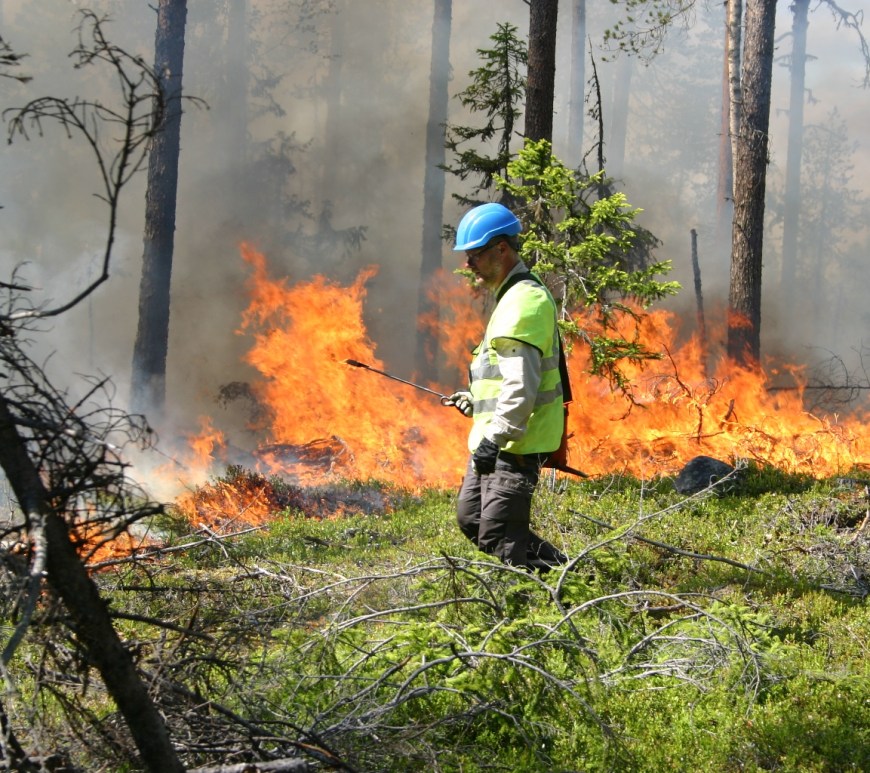
In this podcast Simon Kärvemo discusses his paper ‘Forest restoration as a double-edged sword: the conflict between biodiversity conservation and pest control’ published today in Journal of Applied Ecology. Forest fires create open patches and dead wood – both factors that favour biodiversity, but using fire as a restoration tool is both risky and requires a lot of work and planning. What if we could … Continue reading PODCAST: Forest restoration as a double-edged sword

Forests in 3D

In this post Markus Eichhorn discusses his new article ‘Effects of deer on woodland structure revealed through terrestrial laser scanning‘ About the video: Three-dimensional reconstruction of a transect from Wyre Forest, an area of high deer density. The central 10 X 50 m plot is surrounded by a large number of points which were not used in the analyses. Survey apparatus is still visible. Points … Continue reading Forests in 3D

Forests as an important system for applied ecology

In this post, Associate Editor Akira Mori gives his personal perspective on organizing the recent Special Feature: Forest biodiversity and ecosystem services. One day, I suddenly got an idea to organize a Special Feature, which has a deep focus on several key terms of my research topics from the last several years. These key terms include biodiversity, climate change, ecosystem function, ecosystem services, and most … Continue reading Forests as an important system for applied ecology

Forest thinning: a bat’s friend or foe?

In this post, Rachel Blakey discusses her paper in the latest issue of Journal of Applied Ecology ‘Bat communities respond positively to large-scale thinning of forest regrowth‘ The world’s forests are changing. Most of the remaining forests are re-growing after being cleared, but do these regrowth forests resemble the original primary forests? Often, where large tracts of forests were cleared at once (e.g. clear-felling), they … Continue reading Forest thinning: a bat’s friend or foe?

Traditional forest management practices stop forest succession and bring back rare plant species

In this post Jan Douda discusses his recent paper ‘Traditional forest management practices stop forest succession and bring back rare plant species‘ The past management practices may continue to influence ecosystem functions and processes for decades, centuries or even longer after they have been abandoned. Until now, few authors have attempted experiments which test the effects of restoring some of these past management practices on long-term forest … Continue reading Traditional forest management practices stop forest succession and bring back rare plant species

Bark beetle impacts on ecosystems and society

In this post Jesse Morris discusses his research, published today in Journal of Applied Ecology ‘Managing bark beetle impacts on ecosystems and society: priority questions to motivate future research‘ Forests provide many goods and services that have ecological, economic, and social value. Management agencies and scientists often refer to these benefits as ecosystem services. Some examples of ecosystem services include purifying air, controlling water runoff … Continue reading Bark beetle impacts on ecosystems and society

A new method for assessing the age of old-growth forests

In this post, Associate Editor Nathalie Butt discusses a recent paper ‘Tree-ring based metrics for assessing the functional naturalness of forests‘ by Alfredo Di Filippo, Franco Biondi, Gianluca Piovesan and Emanuele Ziaco. Valuable ecosystems Primeval forest, or ancient woodland in the UK, is an integral part of many epic stories and myths throughout human history, especially in Europe:  just think of all those old tales … Continue reading A new method for assessing the age of old-growth forests

Gone with the wind: canopies of next generation tropical forests will function differently based on today’s understory recruitment

In this post Jarrah Wills discusses his recent paper ‘Next-generation tropical forests: reforestation type affects recruitment of species and functional diversity in a human-dominated landscape‘ Diverse understory development within forest plantations can provide conservation value in highly modified tropical landscapes, but how many species should be used to establish a framework to encourage recruitment: one species, two species, more? And how does the quality of … Continue reading Gone with the wind: canopies of next generation tropical forests will function differently based on today’s understory recruitment