シギ・チドリ類の保全策として重要な干潟上のバイオフィルム

干潟はシギ・チドリ類にとって不可欠な採餌場であるが、気候変動や人為的影響によって深刻な影響を受けている。桑江朝比呂氏らの研究グループは、バイオフィルムに焦点を当てた干潟生態系への積極的介入によるシギ・チドリ類の回復効果について、最新の総説で探っている。A version of this post is available in English. Continue reading シギ・チドリ類の保全策として重要な干潟上のバイオフィルム

Temporal trends in geographic clines of salmon eggs associated with global warming and hatchery programs

Koh Hasegawa and colleagues describe their latest research examining the geographic clines in Japanese chum salmon (Oncorhynchus keta). Many animal and plant species show geographic clines which are often recognized as adaptations to the associated transitional environments. A well-known example is that the body size of bears increase in more northern regions. Even people may notice clines in their daily lives, such as people in … Continue reading Temporal trends in geographic clines of salmon eggs associated with global warming and hatchery programs

Social distancing between plants may amplify coastal restoration at early stage

Climate change and anthropogenic activities are jeopardising coastal ecosystems world-wide. Once degraded, these valuable ecosystems are not easy to recover. In their latest research, Hao Huang and colleagues conducted transplanting experiments to search for the optimal spatial design of coastal restoration. Few ecosystems can equate to coastal wetlands in terms of connections with humans. They provide many ecosystem services that are vital to current societies, … Continue reading Social distancing between plants may amplify coastal restoration at early stage

From blind amoeba to Nemo: the evolution of fish (and vertebrate) vision

This blog is part of our colourful countdown to the holiday season where we’re celebrating the diversity and beauty of the natural world. In this post, Martin Luehrmann of The University of Queensland takes us on a journey through the development of sight through the evolution of fish and early vertebrates. Imagine waking up and the world is black, your eyelids won’t open. You are … Continue reading From blind amoeba to Nemo: the evolution of fish (and vertebrate) vision

Reefs don’t just look better after restoration – they also sound healthier

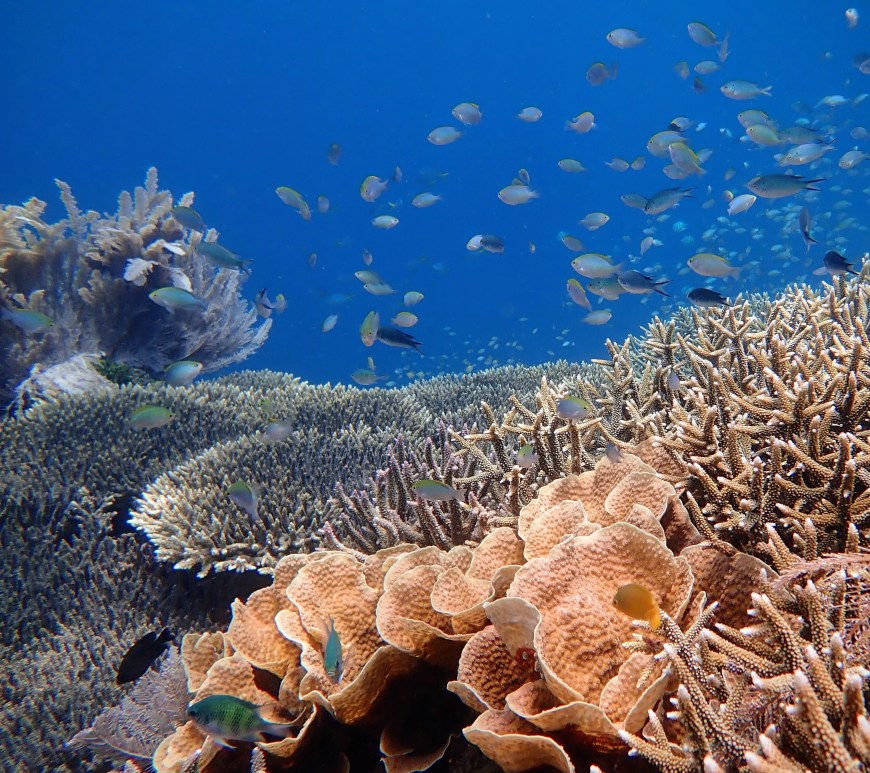
Conservationists are launching bold programmes to actively restore coral reefs around the world, but efforts are hampered by a lack of effective monitoring. In their latest research, Lamont and colleagues explore the use of passive acoustic monitoring for measuring the success of coral reef restoration. Co-author Ben Williams swims us through the study… Over 50% of the world’s tropical reef habitat has been lost since … Continue reading Reefs don’t just look better after restoration – they also sound healthier

Sundarbans in peril: interlinkages between science and society for addressing climate change

This year’s UN Climate Change Conference (COP26) will be held in Glasgow in November. In the lead up to the conference, we’re asking our editors and authors to share their research at the interface of climate and ecology. In this post, Associate Editor Punyasloke Bhadury explains why protecting ecosystems is a priority not just for nature, but for society. Sundarbans, the world’s largest continuous mangrove … Continue reading Sundarbans in peril: interlinkages between science and society for addressing climate change

Tracking data can provide a data-driven approach for high seas conservation

A new Policy Direction by Davies and colleagues showcases a candidate high seas marine protected area (MPA) in the Northeast Atlantic, identified primarily from seabird tracking data, that is being taken forward under a regional process: the North Atlantic Current and Evlanov Seamount (NACES) MPA, under the OSPAR Commission.  The high seas are international waters beyond any country’s jurisdiction. Although out-of-sight, beyond 200 nautical miles … Continue reading Tracking data can provide a data-driven approach for high seas conservation

Where will the whales be? Ecological forecast models present new tools for conservation

Dynamic forecast models predict environmental conditions and blue whale distribution up to three weeks into the future, with applications for spatial management. Founded on a robust understanding of ecological links and lags, a new study by Barlow & Torres presents new tools for proactive conservation. The ocean is dynamic. Resources are patchy, and animals move in response to the shifting and fluid marine environment. Therefore, … Continue reading Where will the whales be? Ecological forecast models present new tools for conservation

Calling all seabirds: restoring long-lost colonies on Desecheo Island

Lead author Jose Luis Herrera-Giraldo describes his team’s latest study using fake birds and loudspeakers to help conservationists restore the long-lost seabird colony of Desecheo Island, Puerto Rico. For scientists and conservationists, life on Desecheo National Wildlife Refuge in Puerto Rico is harsh with the islands’ rugged terrain, blazing hot sun beating down year-round, and fire ant. But for seabirds the island is paradise – … Continue reading Calling all seabirds: restoring long-lost colonies on Desecheo Island

Drones and Citizen Scientists – the future of ecology

Why are the United Nations advocating for citizen science and technology? Using an Australian case study, let’s see how drones and local communities may be the answer to large scale and ongoing ecological monitoring. In the past, research in inaccessible areas has been limited to either small samples sizes, due to high costs and safety issues, or lower resolution data from satellites. However, drones can … Continue reading Drones and Citizen Scientists – the future of ecology