Mind the gap: why flower timing matters to farmland pollinators

A new study by Thomas Timberlake et al. reveals seasonal ‘hunger gaps’ in farmland nectar supplies, which could be limiting pollinator populations. But does this offer an opportunity to devise more targeted and cost-effective conservation and agri-environment schemes for pollinators? Nectar and pollen are crucial resources which give bees and other pollinators the energy and protein they need to fly around, reproduce and maintain their … Continue reading Mind the gap: why flower timing matters to farmland pollinators


Redefining bee-friendly plants: pollen quality versus quantity

Do bees really benefit from our conservation attempts? Michał Filipiak takes a closer look at the factors that determine whether pollen was a healthy food for wild bee larvae or not.  The outcomes have him asking whether we need major shift in the perspective of what we consider ‘bee-friendly’ plants. Take a look at the ‘menu bee’ infographic available here. What are bee-friendly plants? Children, compared … Continue reading Redefining bee-friendly plants: pollen quality versus quantity

Traditional management systems maintain phylogenetically distinct rare species in semi-natural grasslands

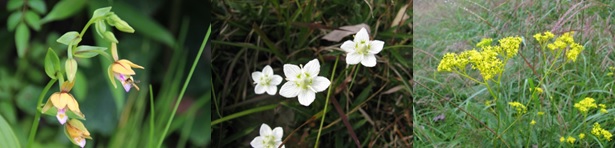
Based on their research in Japan, Kei Uchida and colleagues, highlight why traditional land-use practices need to be upheld if we are to support biodiversity and rare species in semi-natural grasslands. We live in an era of rapidly changing land use. Semi-natural grasslands on the margins of agricultural lands were previously maintained by traditional extensive management practices. But, more recently, a decline in traditional land-use … Continue reading Traditional management systems maintain phylogenetically distinct rare species in semi-natural grasslands

Carnivores without borders: management of transboundary populations when objectives differ

Using the recent case study of wolverines in Scandinavia as an example, Associate Editor, Kulbhushansingh Suryawanshi highlights why management initiatives for transboundary populations need to collaborate across borders – and what happens when they don’t. Globally, carnivore conservation has two very different objectives. First, to protect the population of the carnivore species from going extinct. Second, to mitigate the impact of the carnivore on the … Continue reading Carnivores without borders: management of transboundary populations when objectives differ

Spotlight: Conservation in marine habitats

This month, Journal of Applied Ecology turns its focus to the health of the worlds’ oceans, with a new Spotlight, Conservation in marine habitats. Ignasi Montero-Serra summarizes the importance of this collection of work that provides a variety of cutting-edge tools to quantify the impact of major stressors, and to guide management actions across marine habitats; from the intertidal to the deep sea. Marine habitats … Continue reading Spotlight: Conservation in marine habitats

Can living shorelines survive the rising seas?

Take a sneak preview into our new issue, which publishes this Friday and turns the Spotlight on conservation in marine habitats. The feature includes a Practitioner’s Perspective on designing climate‐resilient living shorelines, which Molly Mitchell and Donna Marie Bilkovic discuss here. Look out for an additional post bringing together all the papers in the Spotlight soon. Living shorelines are a form of shoreline protection that mimics … Continue reading Can living shorelines survive the rising seas?

What can we learn from pollution trading to help us create biodiversity offset markets that do not undermine conservation goals?

Katherine Needham aims to answer this question following her recent  Commentary, Designing markets for biodiversity offsets: Lessons from tradable pollution permits, published in the journal. At the start of 2018, the UK Government outlined its ambitious 25 Year Environment Plan. The very first action is to embed an ‘environmental net gain’ principle for all future developments, including housing. Reconciling the need to build 300,000 new … Continue reading What can we learn from pollution trading to help us create biodiversity offset markets that do not undermine conservation goals?

How to keep the mycorrhizae? The more hosts you leave, the more symbionts you get

How can tree retention mediate the effects of human-introduced disturbance on ectomycorrhizal fungi? Nahuel Policelli  and Senior Editor, Martin Nuñez discuss the recent article, The significance of retention trees for survival of ectomycorrhizal fungi in clear‐cut Scots pine forests. One of the most important above-belowground interactions is that between plants and mycorrhizal fungi. Acting as symbionts, mycorrhizal fungi are involved in plants’ nutrient uptake and … Continue reading How to keep the mycorrhizae? The more hosts you leave, the more symbionts you get

Sustainable intensification: our quest for the ‘holy grail’

Is it possible to meet food demands and increase production without the damaging costs to the environment? Patrick White et al. tackle this challenge in their recently published research in the journal. As the world population grows, our finite land is put under increasing pressure to meet food demands. Historically we have increased agricultural yields by increasing the intensity of agricultural practices – for example … Continue reading Sustainable intensification: our quest for the ‘holy grail’

Cross-journal Virtual Issue: Lianas and Global Environmental Change

Together with Functional Ecology and Journal of Ecology, we’re showcasing  some of the top research recently published in the journals on the topic of lianas and global environmental change. Here Ainhoa Magrach brings the papers together and highlights the important roles lianas play in tropical forests. Lianas are a common feature of tropical forests, contributing up to 25% of woody stems. However, these important tropical … Continue reading Cross-journal Virtual Issue: Lianas and Global Environmental Change