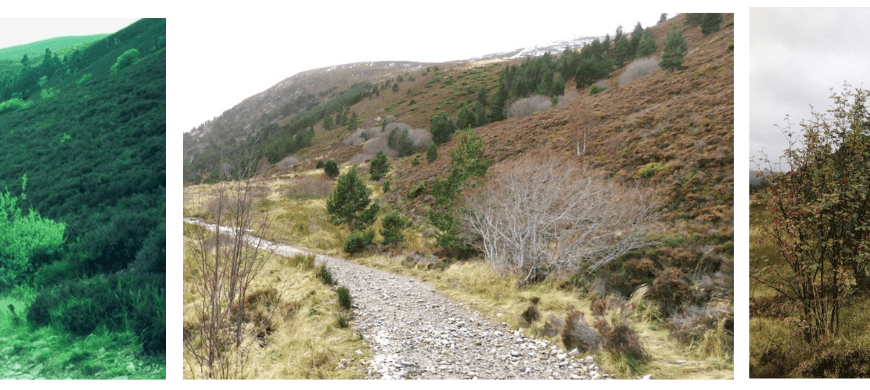
Restoring Landscapes: Cairngorms Connect – a wild landscape in the making

In this new series, we hope to promote knowledge exchange in restoration and invite restoration practitioners to share their stories: successes, failures, implementation of learnings from other places and anything in between! To kick off the series, Sydney Henderson and Dr Pip Gullett share their story from Cairngorms Connect. Cairngorms Connect is a partnership of neighbouring land managers, committed to a bold and ambitious 200-year … Continue reading Restoring Landscapes: Cairngorms Connect – a wild landscape in the making

Rewilding boosts Carbon Storage: How trees channel more Carbon into their roots

Author Nancy Burrell highlights the importance of accurate carbon accounting and describes her team’s latest research into the accuracy of current methods for measuring carbon in scrublands. Traditional methods like the i-Tree Eco model, effective in urban and forestry settings for estimating carbon storage in trees, are based on the growth patterns of plantation trees (trees grown in herbivore-free landscapes). But how does browsing at … Continue reading Rewilding boosts Carbon Storage: How trees channel more Carbon into their roots

Editor’s Choice 60:11 Woodland Expansion in the Presence of Deer

Pip Gullet, Mark Hancock and Sydney Henderson summarise the Journal of Applied Ecology’s November’s Editor’s Choice research article. This study presents 30 years of regeneration monitoring to show a consistent, large-scale expansion of native woodland, largely through natural regeneration alongside deer culling, without the use of fences. Continue reading Editor’s Choice 60:11 Woodland Expansion in the Presence of Deer

Applying remote sensing techniques to wide-scale vegetation inventories

Feature image © InnoTech Alberta Originally posted and adapted from The Alberta Biodiversity Monitoring Institute Blog. Author Sydney Toni describes their latest study that explores a more cost-effective way of using remote sensing to better understand landscapes at larger scale for habitat monitoring and management. Ideally, the information we collect to manage wildlife habitat is many things: high-resolution, consistent and covering all areas of interest. The … Continue reading Applying remote sensing techniques to wide-scale vegetation inventories

Our invaded world: India’s quest for ecosystem restoration

Ninad Mungi shares recent work, conducted with colleagues, which involved monitoring India’s levels of invasive plant species. This has knock-on effects for apex predators, such as tigers, who rely on their prey being able to access native species. Introduction In a world grappling with drastic ecological challenges, biological invasions have emerged as a pernicious threat to biodiversity, ecosystem functioning, and global health. While the impacts … Continue reading Our invaded world: India’s quest for ecosystem restoration

Rewild or Restore – how about doing both?

James Bullock and Nathalie Pettorelli summarise their Perspective piece that highlight the potential for integrating restoration and rewilding agendas into whole landscape approaches. As biodiversity continues to decline at an alarming pace, it is becoming more urgent to not only halt these losses but to reverse them. This reversal of losses, now commonly termed ‘nature recovery’, generally requires improving the state of terrestrial and aquatic … Continue reading Rewild or Restore – how about doing both?

Resolving a heated debate: How useful is prescribed burning for lowland heaths?

Prescribed burning is a controversial management tool. Here, Barbara Smith discusses new research she and colleagues conducted into the impact of burning on lowland heaths at three trophic levels over a 20 year period. Its findings provide evidence for ecologists, land managers and policy makers to support decision making in protected area management. Background Lowland heathlands, with their unique assemblage of species, were created by … Continue reading Resolving a heated debate: How useful is prescribed burning for lowland heaths?

Natural recruitment should be a key goal of tree planting projects

Anna Gee, a PhD student at Imperial College London, talks us through ways in which we can help to restore forests through natural recruitment in this standalone piece. How do we decide what trees to plant for forest restoration? The approach of many restoration projects is to find what is known as a reference forest, a forest that has not been disturbed much by humans, … Continue reading Natural recruitment should be a key goal of tree planting projects

Adaptive staged-scale restoration practices for upland prairies

Shortlisted for the Chico Mendes Prize 2023 Claudia Muzychko shares her latest Practice Insights which documents current on-site activity on Violet Prairie, USA, and provides a management planning reference for prairie restoration. A version of this post is available in Italian. Sometimes in land management we can focus so intently on direct problems complicating our practices that we may not have the space or time … Continue reading Adaptive staged-scale restoration practices for upland prairies

Pratiche di restauro adattativo su scala progressiva per le praterie in altopiano

Claudia Muzychko condivide il suo ultimo studio sulle pratiche in cui viene documentata l’attuale attività in loco nella Violet Prairie, negli Stati Uniti, e fornisce un riferimento per la pianificazione gestionale del restauro delle praterie. Una versione di questo post è disponibile in inglese. A volte, nella gestione del territorio, possiamo concentrarci così tanto sui problemi diretti che complicano le nostre pratiche che non abbiamo … Continue reading Pratiche di restauro adattativo su scala progressiva per le praterie in altopiano