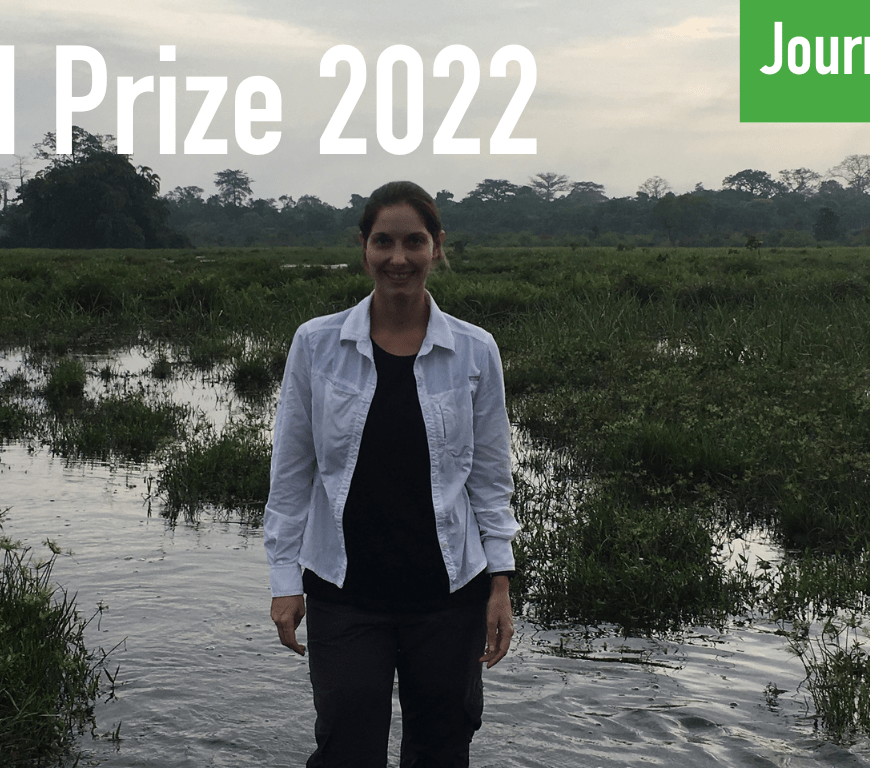
Lucy Dowdall: The Natural Capital approach to estuaries

Shortlisted for the Georgina Mace Prize 2022 In their latest Perspective, Lucy Dowdall and colleagues present a framework for successful recovery of nature in estuaries using the Natural Capital approach. Estuaries are the transitional zones between freshwater rivers and saltwater seas. They are also some of the most complex and unique habitats on earth. They provide important habitats for a wide range of key species, … Continue reading Lucy Dowdall: The Natural Capital approach to estuaries

2022 Spotlight Virtual Issue

We’re thrilled to announce that our 2022 Spotlight Virtual Issue is now available to read! Starting in 2021, the Journal of Applied Ecology Senior Editors select a collection of articles from the previous publication volume to showcase important new research from the Global South. These articles are free to read for the year so that they can be accessed by all ecologists, regardless of their … Continue reading 2022 Spotlight Virtual Issue

Kieran Gething: Predicting invertebrate richness and rarity in aquatic-terrestrial ecosystems

Shortlisted for the Georgina Mace Prize 2022 In their latest research, Kieran Gething and colleagues use a citizen science habitat survey to predict the richness and rarity of invertebrate communities in frequently inundated river sediments in order to guide monitoring and management of these dynamic habitats. River channels and their surrounding areas are dynamic ecosystems in which the extent of water varies in space and … Continue reading Kieran Gething: Predicting invertebrate richness and rarity in aquatic-terrestrial ecosystems

Call for proposals! The influence of beneficial fungi on plant-enemy interactions & plant community structure

Ecologists have mused over the mechanisms that structure plant communities for centuries. One such mechanism is negative density dependence, which has been proposed as a an important promoter of tree species diversity across plant communities. However, most negative density-dependence studies to date have focused on the roles played by insects and fungal pathogens. Less attention has been put on the potential for mutualistic fungi to… Continue reading Call for proposals! The influence of beneficial fungi on plant-enemy interactions & plant community structure

What is the real impact of eco-tourism on the environment?

In this blog post, Andrew Torsney and Yvonne Buckley share findings from their latest research aiming to better understand and identify the drivers of tourism-related impacts on the environment. As we increasingly recognize the ancillary benefits of nature, such as improved mental health, the demand for access to nature is rising. While this presents potential benefits, it also brings conflicts related to environmental management. Research … Continue reading What is the real impact of eco-tourism on the environment?

Luke Potgieter: Prioritizing sites to manage invasive aliens in urban ecosystems

Shortlisted for the Georgina Mace Prize 2022 In their latest research article, Luke Potgieter and colleagues developed a strategic, spatial prioritization approach for identifying sites most vulnerable to new or expanding terrestrial non-native plant invasions in urban landscapes. Cities have historically been under-studied in ecology and have not seen sufficient development of conservation and biodiversity management policy. This dearth of urban-focused applied ecology and conservation … Continue reading Luke Potgieter: Prioritizing sites to manage invasive aliens in urban ecosystems

Multiple incentives to harvest can increase the extinction risk of rare species

Ryan Almeida talks us through recent research on extinction risk with Juan Bonachela and Julie Lockwood. Through a case study on the ground pangolin, or the Smutsia temminckii, the study uses models to consider rare species extinction risk and the rate at which overexploitation occurs. The economics of exploitation Overexploitation, the unsustainable harvest of species from the wild, is recognized as one of the “big … Continue reading Multiple incentives to harvest can increase the extinction risk of rare species

Effective knowledge exchange in forestry: What is it and what’s effective?

Co-authors Jenna Hutchen and MJ Robertson discuss how their latest research in interdisciplinary forest science led to a typology of Knowledge Exchange practices. Managing forests is not as simple as growing or cutting down trees. Global forest management is the complex interplay of government policies and directives, cultural and spiritual values, stakeholder perspectives, and efforts from both industry and conservationists to maintain ecological functions of … Continue reading Effective knowledge exchange in forestry: What is it and what’s effective?

Southwood Prize 2022: Shortlist announced for early career researcher award

Every year Journal of Applied Ecology awards the Southwood Prize to the best paper in the journal by an author at the start of their research career. With entries spanning the 59th volume of the journal, our Senior Editors carefully shortlisted the following 12 papers. Chongzhe Zhang with ‘Leveraging functional traits of cover crops to coordinate crop productivity and soil health’ Elizabeth Koziol with ‘Manipulating plant microbiomes … Continue reading Southwood Prize 2022: Shortlist announced for early career researcher award

Georgina Mace Prize 2022: Shortlist announced for early career researcher award

Each year, Ecological Solutions and Evidence awards the Georgina Mace Prize to the best research article published by an early career author. Today, we present the shortlisted articles for this year’s award based on the previous volume of the journal. This is the third year we’ll be awarding the prize in honour of Professor Dame Georgina Mace, a pioneer in conservation science and policy who was … Continue reading Georgina Mace Prize 2022: Shortlist announced for early career researcher award