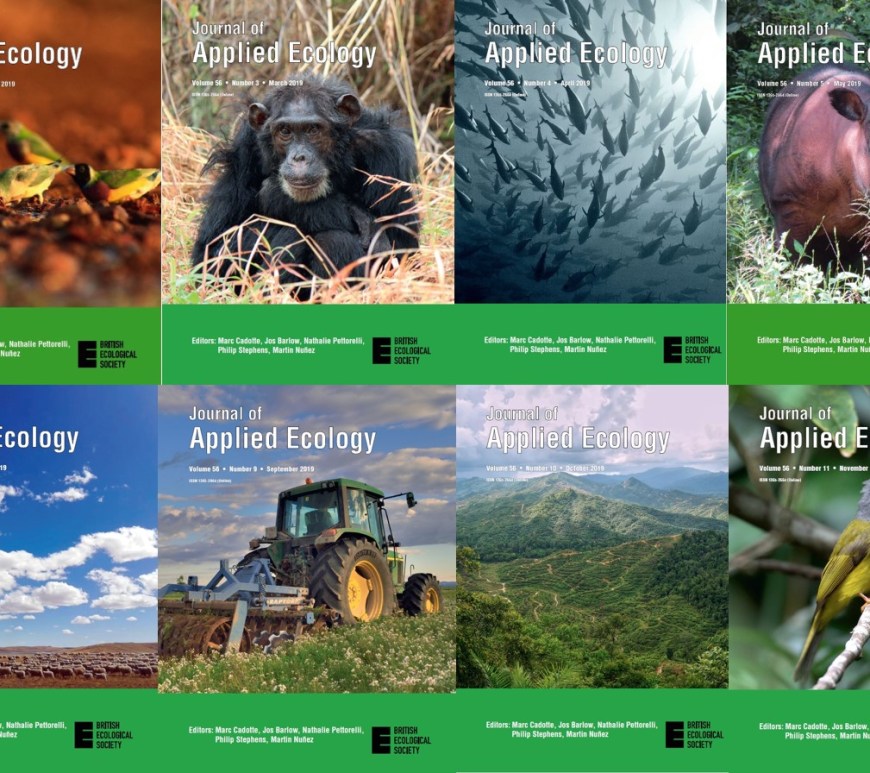
Cover stories: conservation set-asides

This month’s cover image by Robin Hayward (University of Stirling) shows a conservation set-aside within a large oil palm plantation in Sabah, Borneo. Sarah Scriven (University of York), lead author of the corresponding article, Testing the benefits of conservation set-asides for improved habitat connectivity in tropical agricultural landscapes, tells us more about the story behind the photograph. The cover image shows a Roundtable on Sustainable … Continue reading Cover stories: conservation set-asides

Why ecology matters

This week, the British Ecological Society are attending New Scientist Live to showcase Incredible Creatures and bring ecological research to a wider audience. Focused across four zones; jungle, water, nocturnal, and people and nature, we’re excited to share the value of ecology in tackling the biggest challenges faced by our natural world. To celebrate this, we’ve brought together Why Ecology Matters; a selection of articles … Continue reading Why ecology matters

Editor’s Choice 56:10 – How to conduct citizen science that works

Our October Editor’s Choice looks at the value citizen science brings to monitoring programmes and how to ensure that value doesn’t go to waste. Associate Editor, Yolanda F. Wiersma, discusses the selected article, Balancing sampling intensity against spatial coverage for a community science monitoring programme. Citizen science (also termed ‘community science’), the involvement of non-credentialed scientists (‘ordinary citizens’) in a scientific research project, has a … Continue reading Editor’s Choice 56:10 – How to conduct citizen science that works

Cover stories: breeding songbirds alter their singing behaviour in selectively logged tropical forests

Song rates of male songbirds can serve as key indicators of territory quality for females. So what happens when intensive selective logging alters these rates? Rajeev Pillay and colleagues from the University of Florida and Universiti Malaysia Sabah summarise their recent research. *Update November 2019: following the publication of this blog post, the grey-headed canary-flycatcher photo below was selected as our November 2019 cover image. … Continue reading Cover stories: breeding songbirds alter their singing behaviour in selectively logged tropical forests

Green infrastructure: greenwashing or a tangible contribution to urban biodiversity?

What impact does green infrastructure really have on biodiversity in our cities? Associate Editor, Margaret Stanley looks at the recent synthesis and meta-analysis on this topic from Alessandro Filazzola and colleagues. Given the impact of urbanisation on biodiversity, there’s been growing momentum around the world for putting green infrastructure into cities. It’s often designed to support ecosystem services, such as stormwater regulation, but with implied … Continue reading Green infrastructure: greenwashing or a tangible contribution to urban biodiversity?

Private boats in the Mediterranean have extremely high potential to spread alien species

British Ecological Society press release A Mediterranean-wide study has found that 71% of sampled recreational boats hosted alien marine species. Over half carried an alien species that was not yet present in the marina the boat was visiting. The research is published in the British Ecological Society Journal of Applied Ecology. This is the first study in the Mediterranean to combine boat and marina sampling data … Continue reading Private boats in the Mediterranean have extremely high potential to spread alien species

Rewilding needs a conceptual framework. Is the adaptive cycle the answer?

Johan T. du Toit and Nathalie Pettorelli explore the differences between rewilding and restoration. The authors have adapted this post from an article originally shared by ZSL. Rewilding means different things to different people but in applied ecology it is now broadly agreed that the concept means reorganizing, retooling, or regenerating wildness in a degraded ecosystem. Contrary to what many seem to think, rewilding is … Continue reading Rewilding needs a conceptual framework. Is the adaptive cycle the answer?

Quality in peer review: tools and resources

From selecting your preferred reviewers to providing the most useful and fair feedback to other authors, peer review can be both challenging and rewarding. In line with Peer Review Week 2019’s theme of quality in peer review, we have curated this selection of tools, tips and articles to help hone your peer review skills and gain clearer insight into what the process involves.  There’s plenty … Continue reading Quality in peer review: tools and resources

Conservando flores conservamos polinizadores?

An English version of this post is available here. La mayoría de los esfuerzos para promover la conservación de polinizadores están enfocados en mantener o incrementar el rango de plantas con flores disponibles para ellos. La razón es simple: las plantas con flores proveen néctar y polen, recursos esenciales para su subsistencia. Sin embargo, los polinizadores dependen de otros recursos que probablemente también determinan su … Continue reading Conservando flores conservamos polinizadores?

Are flowers enough for preserving pollinators?

Research from Buckles and Harmon-Threatt explores how prairie management strategies can affect pollinator communities both directly and indirectly, highlighting why we shouldn’t ignore what’s happening below ground. Associate Editor, Guadalupe Peralta elaborates. A Spanish version of this post is available here. Most efforts to preserve pollinators are focused on maintaining or increasing the range of flowering plants available. The reason behind this is clear: flowers … Continue reading Are flowers enough for preserving pollinators?